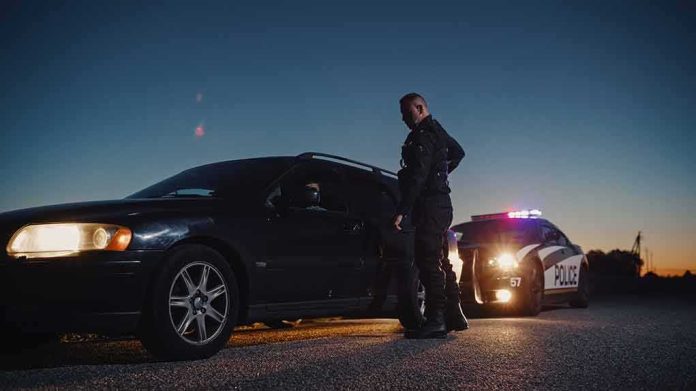
Police touch the back of your car for a reason, and it is not random or nervous habit.
Quick Take
- Officers touching a car’s trunk or taillight is a documented traffic-stop habit, not an accident.
- Police union officials say the touch can leave fingerprints, linking an officer to the vehicle if something goes wrong.
- Officers also use the touch to check the trunk is latched shut before walking past it.
- The gesture doubles as a quick safety check and a moment to watch how the driver reacts.
A Small Gesture With A Specific Purpose
Anyone pulled over has seen it. An officer walks up, taps the trunk lid or brushes a taillight, then moves toward the driver’s window. It looks casual. It is not. Police organizations and veteran officers describe it as a deliberate part of how they approach a stopped vehicle, built around officer safety first and evidence second.
William Johnson, who leads the National Association of Police Organizations, told Snopes the touch is meant to leave fingerprints on the car. If a traffic stop turns violent, that print ties the officer to the vehicle and the moment. It is a small insurance policy, laid down in about half a second, in case the encounter goes bad.
Retired New Jersey State Police Academy instructor Nick Fresolone has described the same idea to reporters: the “taillight tap” proves an officer was physically present at the scene, evidence that matters if a driver later claims the officer was never near the car. That detail sounds small, but in a use-of-force review or an assault case, proving presence and timeline can matter a great deal.
The Trunk Check Nobody Notices
There is a second, more practical reason officers give for the touch. It confirms the trunk is closed and latched before the officer walks past it toward the driver’s door. A loose or unlatched trunk creates a hiding spot someone could pop open, and officers do not want to discover that after they have already turned their back to it.
Some officers and trainers argue this trunk-safety habit is actually the older, more central reason for the gesture, with the fingerprint explanation growing more popular later as a secondary justification. One professional commentary described the fingerprint story as more legend than official doctrine, arguing the simpler, safer explanation is that officers are checking the trunk is secure before they walk within reach of it.
Either way, the effect is the same. A two-second touch buys the officer information: is the trunk secure, and is there any physical give or resistance that suggests something is off. That is useful information gathered in a spot the driver cannot see and cannot easily fake.
Reading The Driver Before The Window Approach
The touch also creates a brief pause officers can use to watch how a driver behaves. Attorneys who cover traffic-stop law note that officers pay close attention to what happens in that short window between the rear touch and the officer reaching the driver’s door. A driver who suddenly becomes anxious, reaches around the cabin, or acts evasively during that pause can shift how the officer approaches the rest of the stop.
None of this means every department writes the exact same rule into a manual, and habits can vary officer to officer. But the pattern across police commentary is consistent: the touch is not superstition. It is a habit built from decades of officers protecting themselves during one of the most unpredictable parts of the job, an unplanned stop with a stranger whose intentions are unknown.
For drivers, the takeaway is simple. That tap on your taillight is not the officer being weird. It is a small, practiced piece of officer-safety training playing out in real time, right before they walk up and ask for your license and registration.
Sources:
engineerfix.com, reddit.com, carparts.com, thelawdictionary.org, instagram.com