

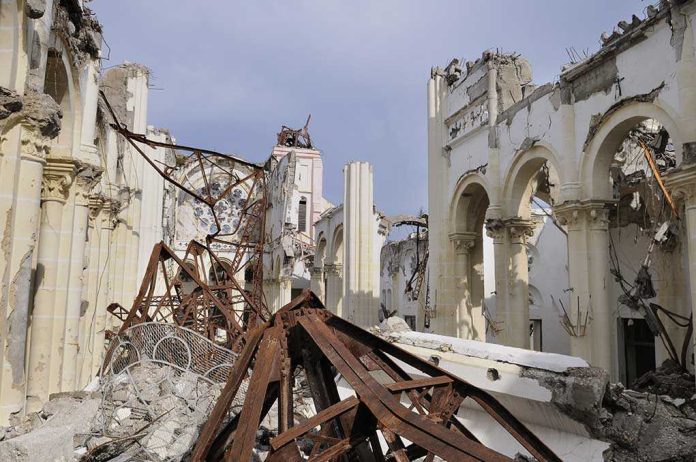
A 140-year-old Catholic landmark in Buffalo is now a burned-out shell, and officials say someone set the fire on purpose.
Story Snapshot
- Officials ruled the latest fire at Buffalo’s former St. Ann’s Church as deliberate arson.
- The blaze hit a long-vacant church already tied up in fights over redevelopment and a possible mosque.
- Squatters, ownership confusion, and repeat fires show how neglected sites become flashpoints for wider anger.
- The case feeds growing public distrust of local leaders and distant investors who let historic buildings rot.
Historic Catholic Church Turned Vacant Flashpoint
Buffalo’s former St. Ann’s Church on Broadway and Emslie Street, once a major Catholic parish, has stood closed and vacant for years as leaders argued over what to do with it. The church complex, including a large school building, became the focus of redevelopment plans after the Catholic Diocese sold the property in 2022 to a private investment group. That group reported plans to turn the site into a Muslim worship space, community center, and health-care facility, pulling a historic Christian building into a heated modern debate.
BREAKING: 140-year-old St. Ann church set on fire in Buffalo, NY
Cause determined to be arson pic.twitter.com/LlA1n5MNsp
— THE GREAT AWAKENING (@Q_1776_United) July 23, 2026
While the church sat empty, local residents watched the landmark decay, worried that neglect would lead to ruin. City and church officials argued over repair costs, demolition, and the future of the property, and private investors moved slowly, leaving the buildings exposed to trespassers and the elements. This mix of religious history, ethnic change, and private profit in a poor neighborhood fed frustration on both the right and left, who see elites making decisions while ordinary people lose both heritage and safe streets.
Repeat Fires End With Arson Finding
In January 2026, a four-alarm fire ripped through the former St. Ann’s school building on the church grounds, gutting the upper floors and roof and causing an estimated $600,000 in damage. More than 100 firefighters responded late at night, and officials later said squatters had been living inside the vacant structure, which had no active utilities. That blaze did not reach the main church itself, but it left the school a roofless shell and raised urgent safety concerns about the entire complex.
Six months later, firefighters were called again to the church site for a new multiple-alarm fire in the rear of the main building, the second major incident there within half a year. Early on, the Buffalo Fire Commissioner said there was a “human element,” with a makeshift bed near where the fire started and boards torn off secured windows, but he cautioned that this did not yet prove arson. Days later, officials announced that the Tuesday fire at the former St. Ann’s Church had been determined to be arson, and that somebody had intentionally started the blaze.
Redevelopment, Mosque Talk, and Online Anger
Local reports say the 2022 buyers planned to convert the former Catholic parish into a mosque, community center, and health-care facility, but there are now questions about whether they have since sold the site to another party. City officials have said they are still trying to confirm who owns the building, even after the major January fire and the later arson ruling. This confusion over ownership makes it harder to enforce repairs, secure the property, or hold anyone responsible for safety, and it adds to the impression that distant investors, not neighbors, control the fate of key community spaces.
Social media posts reacting to the church fires link the arson finding to the push to convert the site into a mosque, with some users openly guessing that a new Muslim worship complex will rise where the Catholic church once stood. Others suggest the fire clears the way for redevelopment and complain that a historic Christian landmark was allowed to burn while elites talk about new projects that may not serve the existing community. These posts do not offer hard proof about motive or suspects, but they show how quickly a local fire can become a symbol of national debates over religion, immigration, and who really runs American cities.
City Hall, Demolition Costs, and Deepening Distrust
After the January school fire, Buffalo’s mayor said the city would not pay for a roughly $2 million demolition of the St. Ann’s complex, arguing that taxpayers should not bear the cost for a privately owned property. He stated that the owners had been told about their responsibilities and that a “collapse zone” was needed to protect pedestrians from falling debris. Meanwhile, the fire department’s investigation was slowed because damage made it too dangerous to enter the building and fully examine the cause.
BREAKING: 140-year-old St. Ann church set on fire in Buffalo, NY
Cause determined to be arson pic.twitter.com/LlA1n5MNsp
— THE GREAT AWAKENING (@Q_1776_United) July 23, 2026
For many residents, seeing a 140-year-old church burn while city officials debate costs and private owners remain unclear fits a wider pattern: aging buildings in poor areas are left to rot until fire or collapse forces action, and then the people who live nearby pay the price. Some conservatives see this as another example of cultural heritage being discarded in the name of globalist redevelopment, while some liberals see it as neglect tied to inequality and profit-driven planning. Both groups share a core worry that the system protects investors and insiders far more than it protects neighborhoods, history, or faith communities.
Sources:
thegatewaypundit.com, wivb.com, youtube.com, facebook.com, wkbw.com, yahoo.com, audacy.com