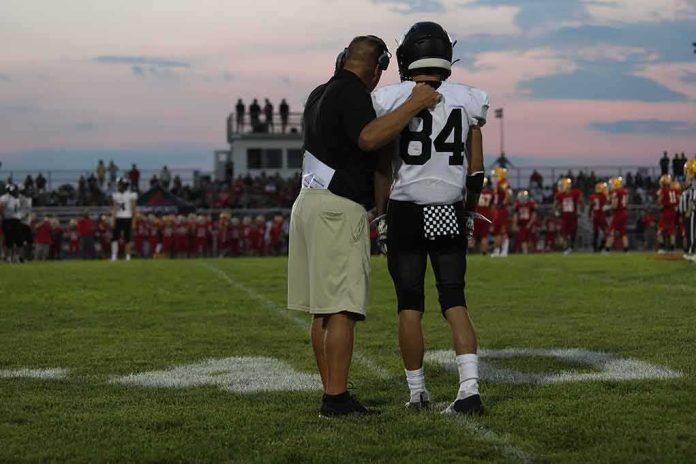
Students say they found a phone recording in a high school boys’ locker room, and police arrested their football coach the next day.
Story Snapshot
- Students found a phone actively recording in a boys’ locker room, then handed it to staff.
- Detectives linked the device to Tracy High School coach Jeffrey Pribble, police said.
- Police arrested Pribble on campus the next day and opened a criminal case.
- The district placed Pribble on leave and began its own investigation.
Police Outline What Happened And Why It Matters
Tracy Police said students in the boys’ locker room at Tracy High School discovered a phone that was recording them as they changed. The students stopped the recording, deleted the footage, and turned the device over to a staff member, according to local reports that cited the police account. Detectives investigated and said they determined the phone belonged to head football coach and teacher Jeffrey Pribble. Police arrested Pribble on Friday and announced an active investigation in a public release.
Police described the alleged conduct as secretly recording identifiable people who were fully or partly undressed in a private area where they expect privacy. That language maps to California’s laws on concealed recording in private spaces, which treat locker rooms as protected areas. Officers interviewed Pribble before taking him into custody on campus, which suggests investigators believed they had enough cause to detain him based on evidence gathered that day. The department said detectives continued to interview students after the arrest.
The School District’s Response And Immediate Safeguards
Tracy Unified School District placed Pribble on leave and said it is cooperating with law enforcement while running its own administrative investigation. The district’s handbooks ban recording in locker rooms and treat student privacy as a baseline rule, so staff are expected to protect that standard every day. The district did not share detailed comment on personnel matters. That limited statement matches standard practice when a criminal case is open and student privacy concerns are in play.
Parents and students want to know how a phone could record in a locker room without instant detection. Schools balance supervision, access control, and trust. But any gap in that chain is a risk. Common sense says locker rooms demand strict rules: tight key control, defined adult access, frequent sweeps, and clear student reporting lines. Conservative values place student safety and parental rights first. That means zero tolerance for covert recording, fast removal of any suspect adult, and full cooperation with police until facts are settled.
What Police Say They Know, And What Comes Next
Local outlets reported that detectives tied the device to Pribble after the locker room discovery and interviews on campus. Police said they believed there may be more than one affected student, and they urged anyone with information to come forward. The department’s public notice labeled the allegation as recording students in an on-campus locker room and confirmed the arrest date and location. As with any arrest, formal charges and court proceedings will guide the next steps.
🚦Tracy High School, CA
On Friday, September 12, 2026, the Tracy Police Department confirmed the arrest of Tracy High School Head Coach and Physical Education Teacher Jeffery Pribble, aged 48. According to a police press release, students discovered a cell phone recording them… pic.twitter.com/q9SVr7ryEQ— Matters of Accountability (@mattersofacct) September 14, 2026
One detail complicates outside review: students reportedly deleted the video before police obtained the device. That does not erase what students say they saw, and it does not block digital recovery methods. Forensic work can often extract deleted files, timestamps, and app logs. If prosecutors proceed, they will need to show the phone’s control, the recording’s timing, and where and how the device was set. That evidence, if confirmed, tends to be decisive in similar school locker room cases.
How Schools Can Shut The Door On Repeat Risks
Locker rooms carry the highest privacy expectations under school law and policy. Courts have said that covert cameras in such spaces violate student rights, period. The clean fix is not complicated. Limit adult access to locker rooms. Log every entry. Prohibit any recording-capable device in those spaces unless there is an emergency. Train staff on boundaries and reporting. Empower students to report odd behavior at once. These steps reflect common sense and align with parent-led oversight that puts kids first.
Sources:
nypost.com, ktvu.com, kcra.com, youtube.com, cbsnews.com, resources.finalsite.net, cms4files1.revize.com