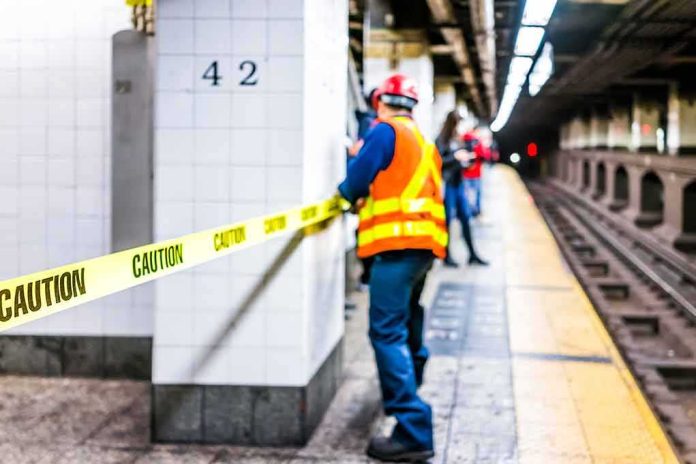
A transit track worker found a man’s body inside a utility closet in an East Harlem subway tunnel late Saturday morning, and police said there were no obvious signs of foul play. The discovery came around 11 a.m. on Saturday, September 26, in a No. 6 line tunnel about 100 feet north of the 125th Street–Lexington Avenue station. Police have not said who the man was or how he came to be in the closet.
Story Snapshot
- An MTA track worker found a dead man in a No. 6 line utility closet near 125th Street and Lexington Avenue around 11 a.m. Saturday.
- Police reported no obvious signs of trauma and do not suspect a crime.
- Emergency Medical Services pronounced the man, who appeared to be in his 20s or 30s, dead on site.
- The city’s Medical Examiner will determine the cause of death; the man has not been identified.
What Police Say Happened Underground
A Metropolitan Transportation Authority track worker was doing work on a tunnel project and found the man inside a utility closet on the downtown side of the No. 6 line, near the 125th Street and Lexington Avenue station in East Harlem. Emergency responders arrived and pronounced the man dead where he was found. Police reported no obvious signs of trauma and said they do not suspect criminality in the case.
A disturbing discovery was made Saturday morning at the 125th Street and Lexington Avenue subway station in East Harlem, where an MTA track worker found a man dead inside a utility closet along the No. 6 line.
The body was reportedly discovered about 100 feet north of the… pic.twitter.com/Q6cxpVNlcv
— World Latin Honey (@WorldLatinHoney) September 27, 2026
A source familiar with the case said the body appeared to have been in the closet for at least a few days before it was discovered. The man appeared to be in his 20s or 30s. His identity has not been established. The city’s Office of Chief Medical Examiner will determine the official cause of death. Officials have not given a timeline for that ruling.
What Happens After a Body Is Found in a Tunnel
Subway tunnels are closed to riders and see little foot traffic outside of work crews. Utility closets along the tracks are meant for work crews, not the public. In this case, a track worker on an ongoing tunnel job found the man. Once police finish at the scene, the case moves to the Medical Examiner, whose exam and lab tests set the cause and manner of death.
A body in a utility closet is not the same as a person struck by a train. Yet headlines often lump these events together as “subway deaths.” That can blur facts that matter for safety and policy. Police can rule out obvious violence at the scene when there are no outside wounds. The autopsy and lab work are what sort out natural causes, overdose, exposure or a hidden injury. Police have not released anything beyond their first findings at the scene.
Safety, Accountability, and Public Trust
New Yorkers across the political spectrum care about safety, cost and basic competence underground. Riders want secure stations and honest updates. Workers want safe access and clear procedures. A man lay in a closet steps from a major East Harlem station for at least a few days before a track worker found him. Transit agencies focus on keeping trains moving, and the public also counts on clear facts when a human life is involved.
Police said they do not suspect a crime. The Medical Examiner’s ruling will settle how the man died. Whatever that ruling shows, the case puts a spotlight on the spaces along the tracks: who can enter these closets, how often they are checked, and how quickly crews report what they find. Those are practical steps that can prevent more tragedies out of sight and build trust with riders and workers alike.