

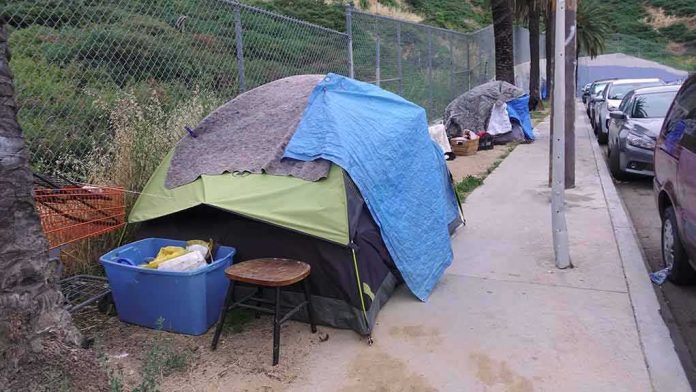
Venice residents frustrated with years of failed homeless cleanups are now paying former gang members to patrol their streets instead of waiting on the city.
Story Snapshot
- Venice residents and businesses are hiring a private group called Ghost Town, staffed by former gang members and former addicts, to clear encampments and mediate disputes.
- A notorious encampment at Rose Avenue and Hampton Drive returned more than three years after Mayor Karen Bass’s Inside Safe program first cleared it.
- City officials admit enforcement gaps let a small group of “service-resistant” people rebuild camps between official no-camping zones.
- Independent research from RAND and UCLA found repeated cleanups often move people around rather than reduce homelessness long-term.
Residents Turn To Private Patrols
About 250 Venice residents now pay a company called Ghost Town to keep encampments off their blocks. The group is led by former gang members and former addicts who act as an unarmed neighborhood watch. They mediate conflicts and clear property lines that police and city crews have struggled to hold.
Today's Ratio Roast 🔥 Gang Law Enforcement Edition
Venice has hired ex-gang members for combat.
A homeless encampment needs not one diplomat.
It feels like a war zone.
Cops' presence is unknown—
Children can't play safely? Take the 'Welcome' doormat.#TorchTheNonsense…— The Ratio Show: The Working Man's Politics! (@LeftysFear) August 17, 2026
One customer described the group as a lifeline after years of watching tents return to the same corners. Fox 11 Los Angeles reported that frustrated business owners turned to the private patrol specifically because city cleanup crews could not keep the areas clear for long. Longreads reported some homeowners feel satisfied with the results, even as some unhoused residents dispute the group’s tactics.
A Cleanup That Did Not Stick
The clearest example sits at Rose Avenue and Hampton Drive. Los Angeles crews cleared a large encampment there in 2023 under Mayor Bass and Councilwoman Traci Park as part of the Inside Safe program. More than three years later, the same corner filled back up with tents, and residents living there told reporters they simply moved around the block and waited for cleanup crews to leave.
City officials have acknowledged the gap. Park’s office said two enforcement zones set up after the 2023 operation “largely prevented encampments of the scale we saw before from repopulating,” but added that space between those zones let a small number of people resettle the area. In April, a large cleanup crew again dismantled tents at the same intersection, only for conditions to reportedly worsen again within days.
What The City Says It Has Done
Mayor Bass has repeatedly framed cleanups as only the first step. In an earlier Venice sweep, she said, “It is great that we have cleared it out, and we’ve gotten people housed. But now we need to make sure that that area is not re-populated”. Her office reports 5,808 people moved indoors citywide through Inside Safe and 1,431 permanently housed as of late February.
In Venice specifically, city officials say outreach connected some encampment residents near Sunset and Pacific avenues with housing after the program’s launch. A separate Care+ cleanup day placed more than two dozen people into housing during a single service event, according to CBS News. These numbers show real placements, even as the same neighborhoods keep drawing new tents.
A Pattern Bigger Than One Beach Town
Venice is not unique. A RAND study reported by the Los Angeles Times found that encampment cleanups across Los Angeles, including Inside Safe operations, produced no long-term drop in unsheltered homelessness in the areas studied. Researchers saw quick drops followed by a return to prior levels within about a month. A separate UCLA Luskin Institute study found that for every one person connected to services during a cleanup, five people were simply displaced elsewhere.
This is not just a Los Angeles story, either. Similar rebound patterns have shown up in Seattle and Norman, Oklahoma, where cleared camps refilled within hours or months. That broader pattern matters because it speaks to a concern shared across the political spectrum: government programs can spend real money and still fail to fix the problem they were built to solve, leaving residents to find their own solutions.
Why Residents Stopped Waiting
For Venice homeowners, the math is simple. City crews clear a block, cameras capture the ribbon-cutting moment, and within weeks or years the tents return. Hiring a private patrol staffed by people who once lived rough on the streets or ran with gangs is not a rejection of city government so much as a sign that residents no longer trust it to finish the job it started.
Sources:
redstate.com, foxla.com, nypost.com, fox.com, x.com, youtube.com, longreads.com, latimes.com, cbsnews.com