

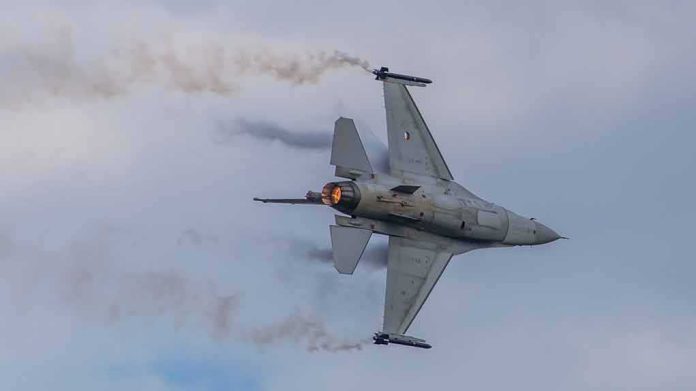
A U.S. Air Force F-16 fighter jet crashed beside an American base in Germany on Tuesday afternoon, September 22, the second American F-16 lost in five days. The pilot ejected and is being treated for injuries.
Story Snapshot
- An F-16 Fighting Falcon assigned to the 52nd Fighter Wing crashed near Spangdahlem Air Base in western Germany around 2:30 p.m. local time on September 22.
- The pilot ejected and is receiving medical care, according to the base.
- The cause of the crash is under investigation.
- It is the second U.S. F-16 lost in a week, after a Texas Air National Guard jet went down in Michigan on September 17.
- Spangdahlem has a long history of aircraft accidents, including a 2019 crash blamed on an electrical failure and bad weather.
Where This Stands Right Now
An American F-16 fighter jet crashed near U.S. Air Base Spangdahlem in western Germany on Tuesday afternoon. The base said in a statement that the pilot “ejected safely and is receiving medical care.” Officials confirmed the aircraft was an F-16 Fighting Falcon assigned to the 52nd Fighter Wing, the unit stationed at Spangdahlem.
The crash happened at about 2:30 p.m. local time, according to the base’s press office. Local fire and emergency crews from the Eifel district of Bitburg-Prüm rushed to the scene after the jet went down near the base. German air traffic control reported the crash came after a training exercise, though the U.S. military has not detailed what the pilot was doing at the time.
Cause Remains Under Investigation
The base has released only basic facts so far. Its statement said plainly that “the cause of the incident is under investigation,” and that more details would come later. That kind of limited early statement is standard for military aviation accidents, since full mishap reports often take months to finish and require detailed technical review before officials can point to a specific cause.
This is the second U.S. Air Force F-16 to crash in less than a week. A Texas Air National Guard F-16 assigned to the 149th Fighter Wing went down during a training mission in Michigan on September 17. That pilot also ejected safely. Two separate F-16 losses in five days puts fresh attention on the aging fighter fleet, even though officials have not linked the two incidents.
This Base Has Seen It Before
Spangdahlem carries a long track record of aircraft accidents dating back decades. In October 2019, an F-16 crashed shortly after takeoff when an electrical failure combined with poor weather, destroying a jet worth an estimated $25.5 million; the pilot ejected with only minor injuries. In August 2015, a Block 50 F-16 assigned to the 480th Fighter Squadron crashed during a training mission, an accident investigators later traced to a structural failure inside the engine’s lower governor ballhead.
Older records show the pattern goes back further. Investigators tied a 1995 crash near Spangdahlem to mechanical failure, and a 2006 crash in the surrounding Bitburg-Prüm district caused no injuries. Military services investigate their own aircraft accidents rather than handing them to an outside agency, a process that differs from how civilian air crashes get reviewed. Tuesday’s investigation will follow that same internal process, with a public report likely once technical teams finish their review of the wreckage and flight data.
Sources:
abcnews.com, aa.com.tr, apnews.com, twz.com, reuters.com, dw.com, abc7chicago.com