
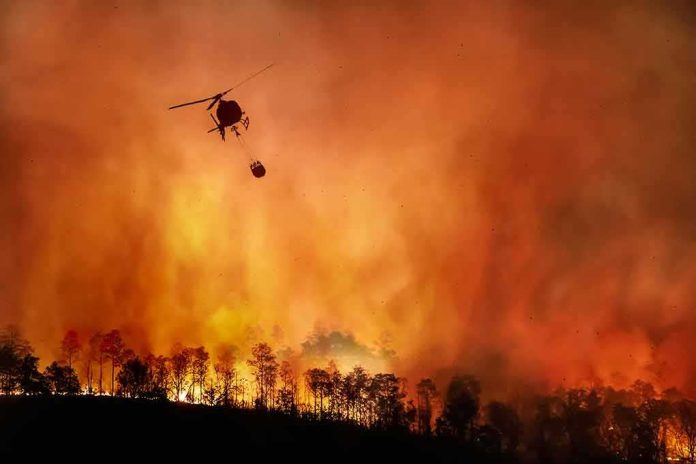
They were in the middle of a water run. On the afternoon of Sunday, September 20, a firefighting helicopter working the Dome Fire in Yosemite National Park was cycling between a water source and the fire line — pick up, fly, drop, repeat — when it went down southeast of Ostrander Lake. Two pilots were aboard. They were the only ones aboard, and both were killed.
Where This Stands Right Now
- The crash happened the afternoon of September 20, 2026, with reported timing ranging from just before 3 p.m. to “Sunday afternoon.”
- Federal aviation officials say the aircraft went down during water bucket operations on the Dome Fire.
- The crash site is southeast of Ostrander Lake, inside Yosemite National Park, with some reporting placing it near Mariposa County.
- Two people were aboard and both died. No injuries on the ground have been linked to the crash.
- The cause is unknown. The Federal Aviation Administration has opened an investigation and the National Transportation Safety Board will lead it.
- The pilots have not been publicly identified.
The Run They Were On
A bucket operation is the most repetitive work in aerial firefighting and among the most demanding. The aircraft carries a collapsible bucket slung beneath it on a long line, dips it into a lake or a portable tank, lifts several thousand pounds of water, flies it to the fire, releases, and turns back for another load. On an active fire a crew may run that loop dozens of times in a shift. Every part of the cycle happens low and slow, which is where the margins are thinnest — heavy loads, shifting winds off the fire, smoke cutting visibility, and terrain close on every side.
That is the work these two were doing when the aircraft came down. It is worth saying plainly, because it is the part that is actually known: they were not transiting, not repositioning, not waiting. They were on the line.
What Is Not Yet Known
Almost everything else. Officials have not released a cause, a tail number, the final flight path, or maintenance records. Reporting has not settled on a single model designation — some accounts identify the aircraft as a Eurocopter AS332 Super Puma, others use an AS32 label — and outlets have variously described the two aboard as pilots, crew members, or firefighters. What every account agrees on is two aboard, two lost, no survivors.
That inconsistency is normal in the first day of an aviation accident and it is not a sign anyone is hiding anything. It is what the record looks like before investigators have finished their first pass. The NTSB typically issues a preliminary report within a few weeks, then a full docket, then a probable cause much later. No release date has been given.
Why This Work Kills People
Federal safety reviews of fatal wildfire aviation crashes keep returning to the same handful of causes: engine or component failure, loss of control, striking terrain or obstacles, and hazardous weather. A Centers for Disease Control review found those four categories account for most fatal crashes in wildfire operations.
NTSB reports from other fires add the specific hazards of rotary-wing bucket work — loss of tail rotor effectiveness in gusty air, power limits exceeded in heat and at altitude, and contact with trees or with the long line itself. None of that has been assigned to this crash, and it would be wrong to guess. It is simply why investigators pull weeks of records before naming a cause, and why this kind of flying is treated as hazardous duty by everyone who does it.
The Fire They Were Working
The Dome Fire began on September 15 near Wawona, in the southern part of Yosemite National Park. By the time of the crash it had grown to roughly 4.7 square miles and was about 15 percent contained. It is not among the largest fires California has seen this year, which is its own quiet point: the danger in this work does not scale with the headline. A modest fire in rough country still requires the same low, heavy, repeated approach that these two pilots were flying on Sunday afternoon.
What Comes Next
Investigators will document the wreckage and work through maintenance logs, crew records, dispatch and radio traffic, weather, and terrain. The operator has confirmed the loss of both aviators. The names will come when families have been notified, and the cause will come when it is actually known rather than when people want it.
Until then the record holds one clear thing. Two people flew a heavy aircraft low over burning ground in a national park, on a Sunday afternoon, carrying water toward a fire that had been running for five days — and they did not come back from the run.
Sources:
washingtontimes.com, abc7news.com, fireengineering.com, nypost.com