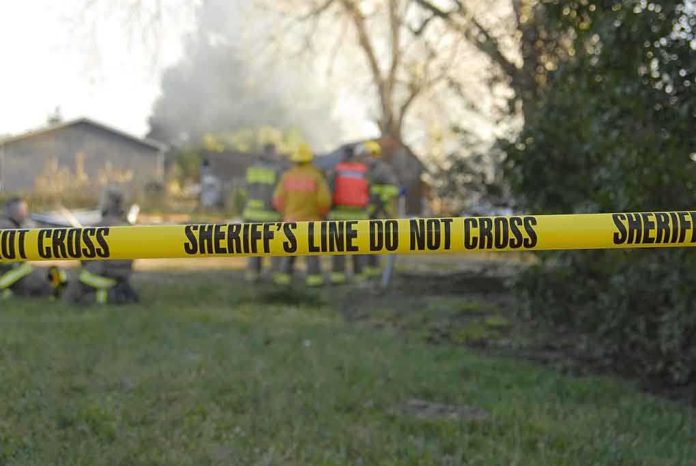
As flames ripped through Spokane County and hundreds of homes burned, detectives say one man with matches and a lighter was walking near the fire’s starting point.
Story Snapshot
- A 37-year-old Spokane man, Aaron F. Farinacci, was arrested on suspicion of first-degree arson in the Old Trails Fire.
- The Old Trails Fire is one of several blazes that destroyed hundreds of structures and forced tens of thousands to flee in Spokane County.
- Investigators say citizen tips, a witness report, and fire science work led them to Farinacci, who had waterproof matches and a butane lighter.
- The case highlights both the demand for accountability after disaster and long-standing worries about fire investigation errors and government power.
Arrest in a wildfire that shattered a community
Spokane County residents watched entire neighborhoods burn while officials said one of the area’s worst fires did not start by accident. The Old Trails Fire, reported around midday on August 1 near Old Trails Road and Euclid Road north of Airway Heights, quickly grew to thousands of acres and became part of a complex of fires that destroyed hundreds of structures and forced massive evacuations across the county. In this chaos, many people felt government had again failed to protect basic safety.
Spokane County Sheriff’s Office Major Crimes detectives and Washington State Department of Natural Resources fire investigators say they worked around the clock to track how the Old Trails Fire began. They describe a clear goal: find the origin of the fire, then the cause, then the person responsible, following modern “origin and cause” standards used in wildland fire investigations. That structured approach is supposed to guard against guesswork, but it also concentrates a lot of power in a small group of experts and officials.
How investigators say they linked one man to the Old Trails Fire
According to the sheriff’s office, tips from citizens, along with information from Airway Heights Police officers and Spokane County deputies evacuating the area, were “extremely valuable” in building the case. Officials say a witness reported seeing a man looking into the trees shortly before smoke appeared near the eventual origin point. That description, combined with location and behavior, helped investigators focus on 37-year-old Spokane resident Aaron F. Farinacci as a suspect.
Law enforcement first detained a man near the scene on the day the fire started, found him carrying waterproof matches and a butane lighter, then released him because they did not yet have enough evidence. As the fire grew and was later officially ruled arson, detectives continued to review witness reports and burn patterns. They say this further work led them to develop probable cause that Farinacci had intentionally set the blaze and to seek an arrest warrant and search warrant from a judge. A judge then set his bail at one million dollars, showing how seriously the system treats suspected wildfire arson.
A suspect with a violent past, a community looking for someone to blame
News outlets quickly reported that Farinacci is a convicted felon with a prior manslaughter conviction in Arizona tied to the killing of his father more than a decade ago. Local coverage also noted past contacts with law enforcement for “arson-related behavior,” although he has no prior arson convictions. For many shaken residents, this record made it easier to believe he was guilty, even before any trial. In a moment of fear and loss, people often want a clear villain.
At the same time, fire science experts have warned for years that arson cases are among the easiest to get wrong when investigators rely on weak methods. Studies of past cases show that accidental and intentional fires can leave very similar damage, and that older burn-pattern ideas helped send innocent people to prison. Modern guides stress that if investigators miss the true origin point of a fire, every later claim about cause can be wrong. That history makes some citizens uneasy when they see officials move fast, especially in a crisis.
Pressure, power, and shared doubts about the system
Wildfire arson cases sit at a tough crossroads of public pressure, fire science limits, and government authority. Residents quite reasonably want someone held responsible when their homes, savings, and sense of safety go up in smoke. At the same time, many Americans on both the right and the left worry about a “deep state” culture where agencies seem more focused on headlines and control than on careful truth. The Farinacci case taps directly into that tension.
A 37-year-old man was arrested on suspicion of first-degree arson for allegedly starting the Old Trails Fire, one of three wildfires in Spokane County burning thousands of acres. https://t.co/z8vj7FQABP
— FOX 4 NEWS (@FOX4) August 4, 2026
Experts say the best safeguard is transparency: full release of warrant affidavits, detailed origin-and-cause reports, and access to witness statements and scene data so both sides can test the story. For now, the public mostly sees law-enforcement press releases and dramatic fire footage, but not the full investigation file. As Spokane moves from shock to rebuilding, many citizens will judge not only whether the right person is convicted, but whether the system showed it could be tough on real crime without cutting corners or abusing its power.
Sources:
washingtontimes.com, spokanecounty.gov, youtube.com, khq.com, livemint.com, independent.co.uk, deathpenaltyinfo.org, nafi.org, digitalcommons.lmunet.edu, fs-prod-nwcg.s3.us-gov-west-1.amazonaws.com