
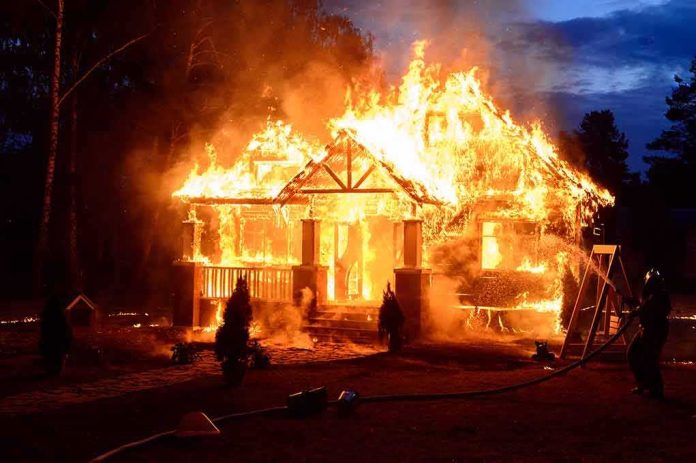
Eight relatives, including four children, were shot and killed at a Billings home that then burned, in what officials called a family disturbance.
Story Snapshot
- Police say a family dispute in Billings ended with eight dead and a house in flames.
- Dispatch logged the call at 6:01 p.m.; officers heard gunfire minutes before the home was engulfed.
- Four adults and four children were killed; the suspect died of a self-inflicted wound.
- A family member identified the shooter as 44-year-old Alan Smith as questions about motive persist.
What Police Say Happened In Billings
Billings police and Yellowstone County deputies rushed to a house on White Star Circle after a 6:01 p.m. call on August 25. Officers reached the scene about 10 minutes later and heard gunfire from the back of the property. Within minutes, flames swept the home. Firefighters could not enter safely. Investigators later confirmed that four adults and four children died. Police said the case began as a family disturbance, not a random attack, based on early evidence and witness accounts.
Officers found a man in the backyard with what looked like a self-inflicted gunshot wound. Medics took him to a hospital, where he died. Officials have treated the house as a homicide scene and fire scene in one. That slowed recovery and made identification harder. The blaze burned the structure down to its foundation, complicating how and where investigators could search for answers and retrieve remains safely for the coroner.
Identities And A Possible Motive
An Associated Press report quoted family naming the shooter as 44-year-old Alan Smith. The same report listed several relatives among the dead and said the victims were gathered for a family meal. The report added that relatives said Smith’s parents had asked him to move out. Police have not issued a full official list of names, which is common until the coroner completes work and next of kin are reached. The suspected motive remains unconfirmed by investigators.
Naming by relatives often happens before a police release, especially in close-knit towns. That speeds public understanding but does not replace formal identification. In this case, both national and local outlets matched on the core facts: eight dead, gunfire heard by arriving officers, and a fast-moving fire at the same address. The scene span covered the 300 block of White Star Circle on Billings’ West End, where emergency crews fought flames and secured the perimeter for much of the night.
How The Timeline Unfolded On Scene
Dispatchers sent police and fire at 6:01 p.m. Officers arrived about 10 minutes later as shots rang out from behind the house. Three minutes after that, the home was fully engulfed, according to reporting that aligned with police briefings. That speed forced responders to shift from rescue to perimeter control. The fire destroyed potential evidence, from shell casings to burn patterns inside rooms, which will require more lab work and interviews to reconstruct the sequence.
Investigators will now lean on several steps. They will examine bullet paths and collect samples to test for accelerants. They will request phone records and messages. They will also map witness statements against the dispatch and radio logs. The county coroner will confirm the cause and manner of death for each person. That work will help decide whether smoke, fire, or gunshots caused specific deaths and whether the suspect acted alone from start to finish.
Why This Fits A Wider Pattern Of Family Mass Murder
Researchers who study mass killings say cases inside families often look different from public attacks. These crimes can mix gunfire and arson, and they often include child victims. One study found that arson was more likely when shootings and child victims were part of the case. That pattern matches what Billings officials have reported so far: a family setting, gunfire, and a home that burned fast and hot while people were still inside.
12-year-old girl killed in Montana massacre was 'hero' who called 911 trying to save her family https://t.co/1Zc0v3jiEf pic.twitter.com/cdgGJB9YkZ
— New York Post (@nypost) August 26, 2026
These tragedies cut across politics because they expose basic failures that feel close to home. Families struggle to spot danger in time. Systems that should protect kids and elders often arrive only after the worst has happened. Police face split-second choices with little information. When fire erases a scene, answers can take weeks. That delay frustrates everyone. It also deepens a shared fear that our institutions reveal hard truths only after lives are already lost.
Sources:
thegatewaypundit.com, abc7chicago.com, nypost.com, cnn.com, king5.com