
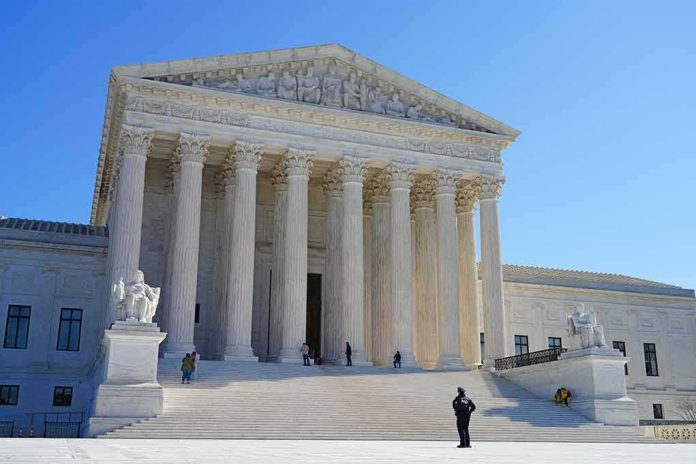
The party-paid political ads on your TV before the Nov. 3 election can keep running at the bargain price candidates pay, for now, after Chief Justice John Roberts stepped into the fight over who pays what.
Story Highlights
- On Thursday, October 8, Chief Justice John Roberts put a lower court’s order on hold, a win for Republican party committees and the Trump administration’s FCC.
- The order he paused had told the FCC to rule by Friday, October 9, on a challenge brought by Democratic candidates, including Georgia Sen. Jon Ossoff.
- The discount at stake is the “lowest unit charge,” the lowest price a TV or radio station charges its best advertisers for the same kind of ad slot, which federal law sets aside for candidates in the last 60 days before a general election.
- Roberts set 5 p.m. Eastern on Saturday, October 10, as the deadline for the Democratic challengers to file their answer. The Court then decides whether the pause stays.
What It Means For The Ads On Your Screen
Roberts’ order keeps the FCC from being rushed into a ruling, and that keeps a cheaper ad price open to the national parties as well as their candidates while the case goes on. Republicans pushed for that price break because their party committees hold a large cash edge. Democrats hold the cash edge among individual candidates, and Democratic candidates sued to end the party discount.
The 60-day window, when stations must offer the discount, opened on Sept. 4. Inside that window, stations must offer the low rate to every qualifying buyer. That matters in a costly midterm year in which control of Congress is on the ballot. Federal filings for July and August show Republican committees spent more than $48 million above the old national limits on coordinated party-candidate spending, while Democratic committees spent a little under $4 million above them. Those limits were struck down by the Supreme Court in June.
The Bargain Rate Behind The Fight
The Federal Communications Commission, or FCC, is the federal agency that licenses and oversees the nation’s TV and radio stations. In March, an FCC office called the Media Bureau issued a notice that opened the lowest unit charge to political party committees and to joint fundraising committees, which are groups that raise money for a candidate and a party together.
Before that notice, the rate had been treated as a benefit for candidates and their own campaign committees. Democrats say the law was written for candidates alone. Republicans say the guidance treats all parties fairly. The FCC has a 2-1 Republican majority and is led by Chairman Brendan Carr, a Trump ally.
Inside The Order Roberts Signed
Roberts issued what is called an administrative stay. That is a short pause that holds a lower court’s order in place so the justices have time to weigh a formal request. His order puts on hold an Oct. 7 ruling by the Fourth Circuit, the federal appeals court based in Richmond, Virginia.
In that 2-1 ruling, the appeals court ordered the FCC to rule by Friday on the Democratic challenge, which had sat with the agency for more than five months. The court wrote that its “willingness to tolerate the FCC’s delay tactics is at an end.” Solicitor General D. John Sauer, the administration’s top lawyer before the Supreme Court, called that deadline “grossly unreasonable” and told the justices the lower court was trying to cut short the commission’s own review.
How The Case Got Here
The Democratic candidates first filed their challenge inside the FCC in April. When the agency did not act, they went to the Fourth Circuit and won a ruling that limited the discount to candidates. In September, the Supreme Court sided with two national Republican committees and brought the guidance back in an 8-1 order. The justices said the Democratic candidates had to wait for the FCC to rule before going to court. Republican campaign committees had warned the Court that without a stay, stations would pull the low rates in the final weeks before the midterms.
What Comes Next
With the challengers’ answer due by that Saturday deadline, the Court will next decide whether to keep the pause in place. The larger question, whether the law lets party committees claim a price meant for candidates, has not been decided on its merits. Until the Court acts again, the low rate stays open to the parties and the ads they pay for.
Sources:
reuters.com, law360.com, thehill.com