

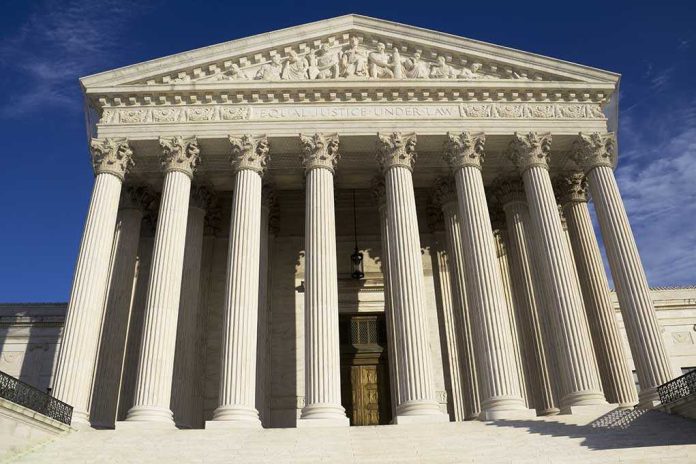
The Supreme Court will hear Asian American parents in Montgomery County, Maryland, who say the county’s magnet-school rules were built to shrink their children’s share of seats.
Story Highlights
- The justices agreed to hear a case over admissions to four Montgomery County middle schools with advanced magnet programs.
- A parents’ group, made up mostly of Asian American families, says race-neutral rules were designed to cut Asian American enrollment.
- Lower courts threw out the case because Asian American students were admitted at least in line with their share of applicants.
- The Court will decide whether families must clear that numbers test before a judge looks at why the rules were written.
High Court Steps Into a New Admissions Fight
The Supreme Court said on Monday, October 19, that it will hear Association for Education Fairness v. Montgomery County Board of Education, because the parents say the county set out to lower the number of Asian American students in its top middle-school programs without ever naming race. The case covers humanities and STEM magnet programs at Takoma Park, Eastern, Roberto Clemente and Martin Luther King Jr. middle schools. A magnet program is a public school program with advanced classes that students apply to join.
The Pacific Legal Foundation, a nonprofit law firm, represents the parents free of charge. “The Constitution protects students as individuals, not as members of a racial group,” said Chris Kieser, a senior attorney with the group. Arguments are expected in early 2027, with a ruling likely by the end of June 2027.
Who Was Cut Out, and How
The county rewrote its magnet admissions rules after a 2016 consultant’s report criticized the racial makeup of the programs, according to the parents’ lawyers. Under the new approach, students were measured against classmates at their own elementary schools, a method called local norming. The parents say that falls hardest on Asian American children, who are clustered in a few high-performing schools. A top student at a strong school was ranked against other top students, while the same scores could stand out at another school. The parents say the district expected Asian American enrollment to drop.
The parents formed their group soon after the change and sued in 2020. During the pandemic, the county moved to a lottery, with grades and test scores also part of selection, and the complaint was amended to cover it. Montgomery County Public Schools spokesperson Liliana López said the Court is taking up a “purely legal question” and that the district “remains committed to providing equitable access to rigorous opportunities for all students.” The county’s NAACP branch and several local groups said the reforms “have opened doors” for students who were left out before.
The Legal Fight: Proving Intent Behind a Neutral Rule
U.S. District Judge Paula Xinis dismissed the case in July 2022. In February 2026, a three-judge panel of the Fourth Circuit, the federal appeals court that covers Maryland, upheld that ruling. Under the circuit’s earlier rulings, a policy written to hurt one group can stand as long as that group’s share of admitted students is at least its share of applicants. The parents call that a loophole. The Second and Third Circuits have rejected that numbers test, according to the parents’ lawyers.
The Court will decide whether families challenging a facially neutral policy, one that never mentions race, must first show that their group as a whole lost seats compared with its share of the applicant pool. That matters well beyond Maryland. After the Court’s 2023 Students for Fair Admissions ruling ended race-based college admissions, many schools turned to rules based on income, neighborhood and lotteries. In 2024, the Court declined to hear a similar case over Thomas Jefferson High School in Virginia, though three justices said they wanted to.
What This Means for Families, Merit and Local Control
For the families in this case, the issue is simple: a child’s hard work should count the same no matter which elementary school she attended. If the Court sides with them, districts could be required to explain why they chose each rule, not only point to the final numbers. That would give parents a real chance to show what officials meant to do.
Many conservatives see a basic principle at stake: the government cannot do by stand-in what it cannot do by name. If a district designs its rules to push one group out, the parents argue, that is discrimination whatever the label. The district says its process is fair and open to all. The justices will set the bar families must clear to have that argument heard in court.
Sources:
reason.com, usnews.com, usatoday.com, edweek.org