

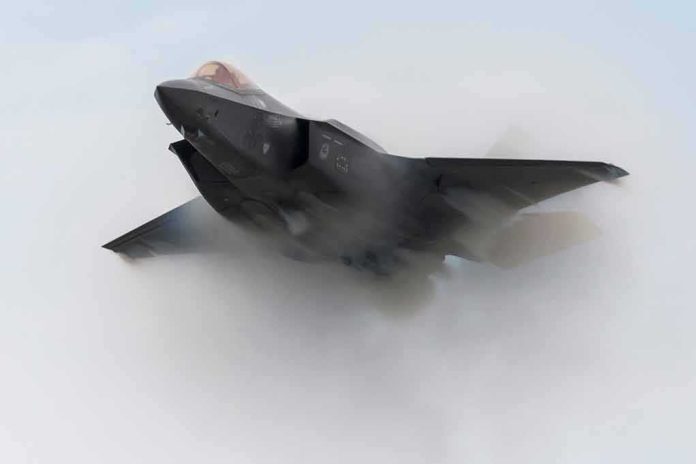
A NORAD F-16 fighter jet intercepted a private plane that flew into the protected airspace over Mar-a-Lago, President Trump’s Florida home, and the pilot was steered back out.
Story Highlights
- A NORAD F-16 intercepted a small private plane at about 12:20 p.m. over Palm Beach, Florida.
- The plane had entered a Temporary Flight Restriction, a no-fly zone the government sets over Mar-a-Lago.
- The fighter flew a “headbutt” move to get the pilot’s attention, and the pilot made radio contact and left.
- NORAD says fighters have intercepted more than 60 planes around Palm Beach since January 2025.
NORAD Confirms Intercept Over Palm Beach
On Saturday, October 24, at about 12:20 p.m., an F-16 fighter jet intercepted a general aviation plane, meaning a private civilian aircraft, over Palm Beach. The jet was flying for NORAD, the North American Aerospace Defense Command, the U.S. and Canadian command that guards the skies over North America. The plane had flown into a Temporary Flight Restriction, or TFR, over Mar-a-Lago. A TFR is a temporary no-fly zone that the Federal Aviation Administration and the Secret Service set up over places like the president’s home. NORAD has not said who the pilot was or why the plane flew in.
According to NORAD, the F-16 used a standard “headbutt” maneuver, in which the fighter flies in close where the pilot can clearly see it. The move worked. The pilot got on the radio with controllers and flew out of the restricted airspace, following instructions. NORAD did not release the plane’s type or tail number.
Pattern of Repeated Palm Beach TFR Violations
This was far from the first time. At a briefing on Tuesday, October 6, NORAD officials said fighter pilots had intercepted more than 60 aircraft violating the flight restrictions around Palm Beach since January 2025. Maj. Anthony Olive, a NORAD senior operations duty officer, called that number “a lot.”
Officials said most of the planes are small, single-engine aircraft. Palm Beach is busy with private flying because of its good weather, its flight schools and its coastline. The rules come in two rings, officials said. The inner ring, 10 miles wide, is a no-fly zone. The outer ring, 30 miles wide, requires pilots to file a flight plan, use an assigned transponder code, which is a signal that identifies the plane on radar, and stay in touch with air traffic control.
Why These Incidents Keep Happening
Officials say the large majority of these cases are pilot mistakes, not threats. Some pilots have permission to fly but forget to enter the right transponder code, so NORAD must still respond because it cannot confirm what they intend. Others do not know they are not allowed in the area, or skip their flight planning. Olive said that, in his experience, he had not seen bad intentions.
The pattern is an old one. Federal auditors found that private general aviation pilots caused about 88 percent of all violations of restricted U.S. airspace in the years after the September 11, 2001, attacks. NORAD’s message after Saturday’s intercept was simple: always read your NOTAMs before takeoff. A NOTAM, or Notice to Air Missions, is the FAA alert that tells pilots about restrictions like this one.
Security, Accountability, and Pilot Responsibility
NORAD also spelled out what an intercepted pilot must do. The pilot should come up at once on the emergency radio frequencies, 121.5 or 243.0, and turn away until given more instructions. Pilots who break a TFR can face federal enforcement action after they land. Those penalties are handled by the FAA.
For Americans, the takeaway is reassuring. The shield around the president’s Florida home is active, and it works. Fighter pilots regularly patrol when a restriction is active, and radar tracks planes that cross into the zone. Most of these stories end the same way this one did, with a safe escort and a reminder to every pilot to read the rules before takeoff.
Sources:
dvidshub.net, wptv.com, gao.gov