Five injured workers, a crippled morning commute, and a power failure deep under the Hudson have turned one “work train fire” into a sharp test of how much chaos American travelers will tolerate from their national rail lifeline.
Story Snapshot
- Amtrak says the Penn Station work-train fire was an accident under investigation, not proven negligence.
- Five railroad workers were injured, two seriously, and service along the Northeast Corridor was heavily disrupted.
- Officials described electrical damage and possible contact between work trains in a tunnel already under repair.
- The clash has begun between “unforeseeable incident” spin and public suspicion of deeper system failures.
How a middle-of-the-night maintenance job became a commuter nightmare
Firefighters were called around 1:30 a.m. to a train car fire on an Amtrak work train near New York Penn Station, inside the Hudson River or nearby tunnels that feed the busiest rail hub in the country.[1][3] The fire reached a two-alarm level by about 3 a.m. before crews got it under control roughly an hour later.[1] By dawn, that overnight incident had snowballed into suspended Amtrak and New Jersey Transit service, stranded passengers, and a fresh round of anger at rail authorities.
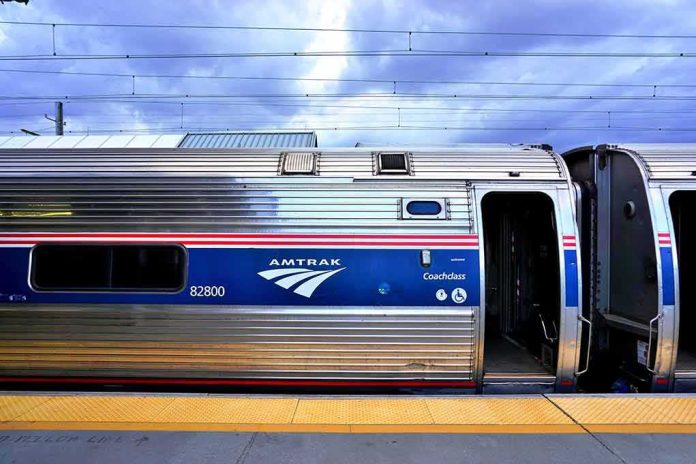
Amtrak described the problem publicly as a fire on a “work train” or maintenance vehicle, not a passenger train, and stressed that the blaze was extinguished and under investigation.[1][3] Local transportation officials echoed that early framing, treating it as an operational emergency to be contained, not yet a scandal to be explained. The working message: no terrorists, no runaway train, just a serious but manageable incident in the bowels of aging infrastructure.
The human cost behind the technical language
Five workers suffered injuries in the fire and its immediate aftermath, with at least two transported to Bellevue Hospital in serious condition.[1] Three others refused medical treatment, which usually signals a mix of minor injuries and people who believe they are fine but have clearly been through something traumatic.[1] Behind the sterile phrase “work-train fire” are real people who were down in that tunnel when things went very wrong in a very unforgiving environment.
For riders, the pain came a few hours later. Amtrak service between Washington, Philadelphia, and New York was suspended for much of Friday, with the company warning that routes between New York and New Jersey and points south would not resume until later in the afternoon.[1] Service north and east of New York ran at reduced levels.[1] New Jersey Transit, Long Island Rail Road, and Amtrak passengers scrambled for alternate routes or simply gave up and went home. Commuters in the nation’s biggest metro area were reminded again that one failure point in a tunnel can ripple all the way down the Northeast Corridor.
Accident under investigation, or preventable failure in a long-suffering system?
Amtrak and allied officials framed the fire as an accident under active investigation, with no immediate evidence of rule-breaking or intentional wrongdoing.[1][3] That is the standard first response in American rail incidents: gather facts, preserve data, stabilize the scene, avoid pointing fingers. Given the complexity of event recorders, signal logs, power systems, and maintenance records, serious investigations often take months. That caution is appropriate if the goal is truth rather than political theater.
Yet details emerging from local reporting invite harder questions about safety culture and basic competence. Regional coverage has described an electrical fire in or near a third rail, in a tunnel already under repair from prior storm damage and reportedly involving two Amtrak work trains making contact and affecting the electrical system.[2] An electrical event in a confined tunnel, on infrastructure you already know is fragile, is exactly the kind of risk that proper planning and conservative operating rules are supposed to anticipate and prevent, not brush off as bad luck.
Why conservative common sense distrusts the “nothing to see here” line
From a common-sense, conservative perspective, the main concern is not that anyone set out to hurt workers or commuters. The concern is that a federally supported rail operator sits on critical infrastructure and still allows situations where a maintenance vehicle can ignite, injure five employees, and shut down a multistate transport artery for hours.[1] That does not look like a one-off fluke; it looks like the predictable outcome of aging assets, slow modernization, and weak accountability for performance.
💬 MTA head rips Amtrak after train car fire sparks another transit fiasco at Penn Station https://t.co/1uSwCB8CPH
🎤 @mackrosenberg reports
📸 MTA, Amanda Alexandre, Glenn, Schuck, AP Photo/Richard Drew pic.twitter.com/EHKXlUeACm
— 1010 WINS on 92.3 FM (@1010WINS) May 29, 2026
New Yorkers have watched this pattern for years: fire in a yard, smoke in a tunnel, signal problems, “power issues” on summer afternoons. Each time, officials talk about investigations and infrastructure challenges, then service limps back and life goes on. The blunt question that aligns with conservative values is simple: who is personally responsible when preventable risks keep injuring workers and stranding taxpayers who already bankroll the system through subsidies and some of the highest fares in the country?
What this fire reveals about the future of Northeast rail
This episode under Penn Station captures the larger crossroads for Northeast rail. On one side is the official script: rare incidents, heroic first responders, long-term capital plans, and more funding someday to fix it all.[1] On the other side is the lived reality for riders and workers: critical tunnels that depend on fragile electrical systems, maintenance trains that catch fire, and a culture that seems quicker to manage public relations than to enforce uncompromising safety and reliability standards.
If investigators ultimately find that this fire stemmed from faulty equipment, sloppy procedures, or rushed overnight work, a serious response would go beyond another report. A serious response would name names, change rules, and link leadership pay and job security to concrete safety and uptime metrics. If, against expectations, it proves truly unforeseeable, then Amtrak should welcome independent verification and public disclosure. Either way, Americans who rely on the Northeast Corridor deserve more than another shrug about “a work train that caught fire.”
Sources:
[1] Web – Fire on Amtrak train at New York’s Penn Station injures five
[2] Web – Amtrak work train fire near Penn Station injures 5, snarls NJ Transit
[3] Web – Amtrak, NJ Transit services suspended at Penn Station in New York …