
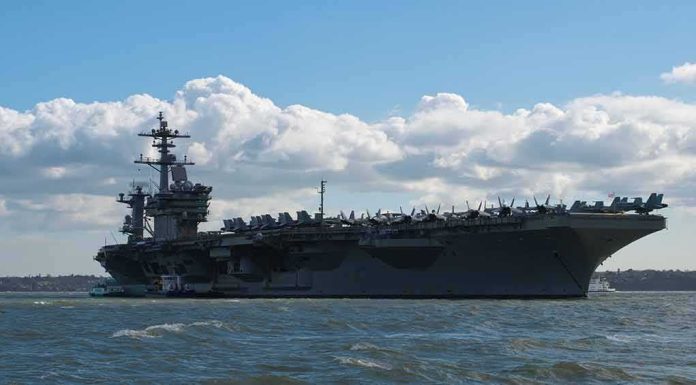
In 1967, one stray rocket and a load of old, unstable bombs turned the deck of the carrier USS Forrestal into an inferno that killed 134 men.
Story Highlights
- An electrical fault fired a Zuni rocket from a parked F-4 Phantom fighter jet into a fueled, armed A-4 Skyhawk attack jet.
- Old 1,000-pound bombs, carried because newer ones were in short supply, fell into the burning fuel and blew up.
- The fire killed 134 sailors and aviators, injured 161 and destroyed 21 aircraft.
- Lt. Cmdr. John McCain, the future U.S. senator, was in one of the jets caught in the first flames, and survived.
How the Fire Started
The Forrestal was launching planes for a bombing strike on North Vietnam from Yankee Station, the Navy’s operating area in the Gulf of Tonkin, when disaster struck just before 11 a.m. on Saturday, July 29, 1967. As the pilot of an F-4 Phantom switched his jet from outside power to its own power, several electrical faults set off a Zuni rocket, a 5-inch unguided rocket carried under the wing. It shot across the deck and ruptured the fuel tank of an A-4 Skyhawk. Jet fuel poured out and caught fire under the parked planes.
The Navy’s investigation board concluded the rocket hit the Skyhawk flown by Lt. Cmdr. Fred White. Some witnesses placed the hit on the jet beside it, flown by Lt. Cmdr. John McCain, who later served as a U.S. senator from Arizona. Shrapnel struck both jets, and the burning fuel spread under both of them. Both pilots climbed out. McCain survived. White did not.
Why the Bombs Were There
The danger came from what was waiting on the deck. The Navy was dropping bombs on North Vietnam faster than new ones could be made, and it was short of its standard Mark 83 bombs. So the Forrestal had taken on older AN-M65 bombs the day before. They were more than ten years old and in poor shape. According to reports, the ship’s ammunition storage was already full, so the bombs sat on the crowded flight deck among armed jets.
The ship’s captain, John Beling, considered the old bombs a serious safety hazard, and his ordnance officer said they should be dumped overboard. Doing that would have meant canceling that day’s mission over North Vietnam. Beling reluctantly accepted the risk. When the rocket hit, at least one of those bombs, and probably two, fell into the flames.
94 Seconds
Chief Gerald Farrier, who led the ship’s specialized firefighting team, rushed in and smothered a bomb with fire-suppressing powder. About a minute after the fire began, the bomb split open. At one minute and 34 seconds, it exploded. The blast killed Farrier, nearly all of his team and Lt. Cmdr. White. A second bomb went off nine seconds later. In all, at least nine bombs exploded on the deck, eight of them the old AN-M65s.
The blasts tore seven holes in the flight deck and set off about 40,000 gallons of jet fuel. Burning fuel poured down into the hangar and into sleeping quarters below. Most of the crew had not been trained to fight fires, and some hose teams sprayed water on burning fuel, which spread it and washed away the foam meant to smother it. The deck fire was out by 12:15 p.m., but fires below decks burned until 4 a.m. the next day.
What the Navy Changed
The Navy’s investigation cleared Captain Beling. The Atlantic Fleet commander, Admiral Ephraim P. Holmes, disagreed and attached a letter of reprimand to the final report, but the Chief of Naval Operations, the Navy’s top officer, ordered it removed. Beling later retired as a rear admiral.
The deeper lessons changed carrier life for good. The Navy brought back firefighting training for every sailor, not just specialists. Carriers got deck washdown systems that spray water or foam across the flight deck. The Navy set up a board to review the safety of its weapons and explosives. Its firefighting school in Norfolk, Virginia, is named for Chief Farrier. The Forrestal fire remains the second-deadliest loss of life on a U.S. Navy ship since World War II.
Sources:
19fortyfive.com, history.navy.mil, en.wikipedia.org