

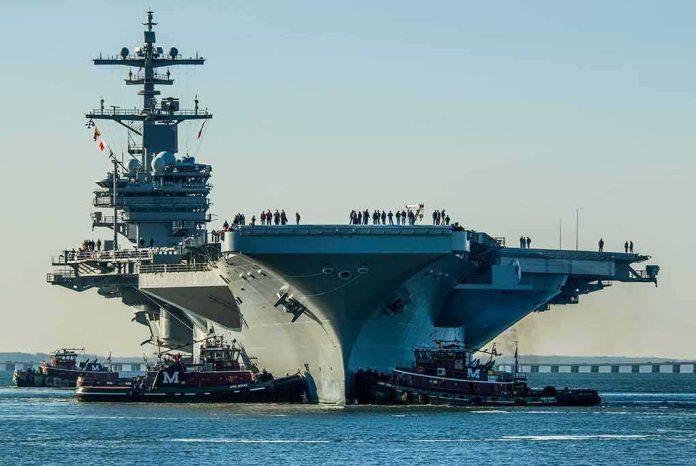
China and Iran may not need a single missile that sinks a U.S. aircraft carrier to beat it in a fight — they just need to knock out its flight deck long enough to stop its planes from flying.
Quick Take
- Military analysts say enemies don’t need to sink a $13 billion U.S. carrier to defeat it in battle.
- A “mission kill” disables the flight deck, catapults, or power systems without sinking the ship.
- China’s missile arsenal and Iran’s shorter-range weapons both threaten carriers from a distance.
- The U.S. Navy is already rethinking how it uses carriers as threats grow.
What A “Mission Kill” Actually Means
A U.S. Navy aircraft carrier can be knocked out of a fight even if it never sinks. Analysts call this a “mission kill.” It happens when the flight deck can’t be used, the catapults or arresting gear break down, or the ship loses electrical power. A fire in the areas where planes are serviced can do the same damage. The carrier stays afloat. It just can’t send planes into the sky anymore.
This matters because a carrier’s whole job is launching aircraft fast and often. Experts call this the “sortie generation rate,” the number of flights a carrier can launch and land in a set time. If a strike damages the deck or the gear that launches and catches planes, that rate can crash even though the ship survives. For an enemy, breaking that system works just as well as sinking the ship.
Why China And Iran See An Opening
China has spent three decades building missiles built for exactly this purpose. Weapons like the DF-21D and DF-26 are designed to strike carriers from hundreds or thousands of miles away. Analysts say China’s real goal may not be sinking carriers at all. Instead, the aim is pushing them farther from Taiwan, which slows their planes and stretches their supply lines thin.
Iran works with a shorter reach but a similar idea. A 19FortyFive report on a hit scenario near Iran notes that even one strike on a flight deck could force the Navy to fight through reduced launch capacity rather than lose the ship outright. In both cases, the enemy doesn’t need to win a knockout blow. It just needs to land one hit that breaks the systems that let a carrier do its job.
Layers Of Threats Facing Every Carrier
Carriers moving toward China face what one analysis calls “concentric rings” of danger, each opening fire at a different distance as the ship sails closer to the coast. Submarines, missiles, aircraft, and satellites all work together in what the Navy calls a “kill chain”: find the ship, track it, then strike it. This layered setup means a carrier faces multiple chances to get hit before it’s even close enough to launch its own planes.
This isn’t a brand-new problem. The same worry appeared during the Cold War, when Soviet cruise missiles and bombers threatened U.S. carrier groups. The Navy answered back then with better radar planes and long-range fighters, not by retiring its carriers. History shows these threats usually change how carriers operate rather than wipe them out completely.
The Navy Is Already Adjusting Course
Chief of Naval Operations Admiral Daryl Caudle rolled out new “Fighting Instructions” in San Diego, signaling a shift toward what’s called a “Hedge Strategy”. This suggests Navy leaders already see the writing on the wall. Carriers may keep serving, but the way they’re used, how close they sail to danger, and what backup ships protect them are all changing to fit new threats.
Some analysts go further, arguing carriers are turning into something closer to the battleships of the past: expensive, powerful, but no longer the main strike weapon. Others push back, saying carriers still bring value even in high-threat zones, largely because of their defenses and their ability to operate from a distance. Either way, the debate itself shows how seriously military planners take the mission-kill threat.
What This Means For Taxpayers And Troops
Each Nimitz-class or Ford-class carrier costs billions of taxpayer dollars to build and keep running. If a single missile strike can take one out of the fight without sinking it, that raises hard questions about how the Pentagon spends defense money going forward. For families with loved ones serving on these ships, it also raises real questions about how the Navy plans to protect its biggest, most visible targets in any future conflict with China or Iran.
The Navy Is Turning Electricity Into Ammunition
Directed energy is giving America’s warships a bottomless defensive magazine — replacing multimillion-dollar missiles with a few dollars of electricity, and making the fleet harder to kill than ever.
On Wednesday, Chief of Naval… pic.twitter.com/Jkn0DK6F8R
— Rod D. Martin (@RodDMartin) September 4, 2026
No single report claims a mission-kill attack has already happened. These are assessments from military analysts studying how future conflicts might unfold, based on known weapons capabilities and Navy strategy shifts already underway.
Sources:
19fortyfive.com, usni.org, maritime-executive.com, navyhistory.org, snu.elsevierpure.com