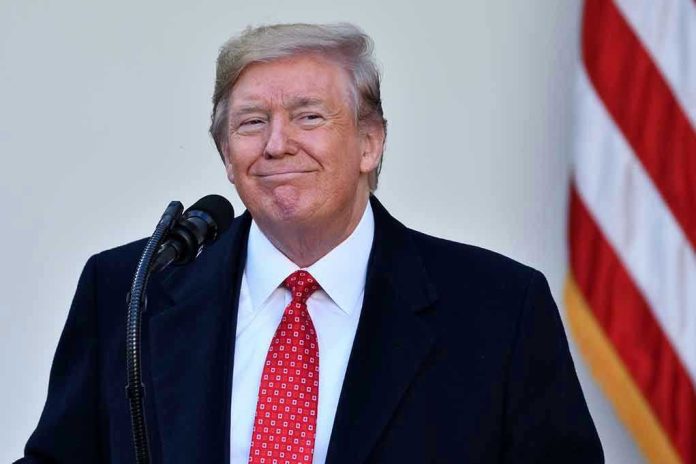
Jon Stewart just handed President Trump rare praise for an executive order that aims to cut decades of red tape keeping promising PTSD treatments away from America’s veterans.
Story Snapshot
- President Trump signed an April 18 executive order designed to accelerate medical treatments for serious mental illness, with a focus on veterans.
- The order targets faster pathways for psychedelic-assisted therapies such as ibogaine for PTSD, addiction, depression, and traumatic brain injury.
- Stewart, usually a sharp Trump critic, told viewers “the president did a solid,” calling the move a meaningful step for veterans.
- The policy puts federal regulators and the VA under pressure to balance speed, safety, and access after decades of restrictions tied to the Controlled Substances Act.
What Trump Signed—and Why It’s Getting Attention
President Trump signed an executive order on April 18 titled “Accelerating Medical Treatments for Serious Mental Illness,” framed as a push to fast-track treatment options for conditions that hit veterans hard. The policy focus includes PTSD, traumatic brain injury, depression, addiction, and other psychiatric conditions where existing treatments often fail. The White House signing drew unusual cultural and political attention because it featured high-profile figures alongside Trump, including Joe Rogan, RFK Jr., Dr. Mehmet Oz, and Navy SEAL Marcus Luttrell.
The executive order’s core premise is speed: directing government agencies to reduce bureaucratic delay and expand pathways that could move new treatments through review more quickly. Based on the reporting available, the implementation elements include expedited FDA review, safe-use protocols, Right to Try pathways, expanded VA data sharing, and support for larger studies. The immediate practical effect is not automatic approval of any specific drug, but a shift in federal posture toward faster evaluation and broader access options for severely affected patients.
Jon Stewart’s “Credit Where It’s Due” Moment
Jon Stewart’s segment aired April 21 and stood out because he praised Trump in plain language rather than treating the policy as a partisan punchline. Stewart told viewers he wanted “to give credit where credit is due,” then added, “The president did a solid.” He also described his own reflex to nitpick Trump—joking about Trump’s pronunciation of “ibogaine”—before pulling back and acknowledging the substance of the policy. That rhetorical pivot mattered because it signaled the issue can break through the usual tribal media framing.
Stewart’s comments also highlighted a practical reality many voters across the spectrum recognize: Washington incentives often reward talking points over results. When a longtime critic publicly credits a president from the other party, the public tends to pay attention, partly because it is so rare. For conservatives, the moment reinforces the argument that outcomes—especially for veterans—should outrank elite consensus and institutional inertia. For liberals, it complicates the assumption that every Trump initiative must be dismissed on principle rather than judged by measurable impact.
The Real Target: A Regulatory System Built in the 1970s
The order’s context traces back to the 1970 Controlled Substances Act, which classified many psychedelics as Schedule I drugs and helped lock in a restrictive research environment for decades. That history matters because it has limited clinical exploration and slowed mainstream medical adoption even as evidence has grown for psychedelic-assisted therapy in treatment-resistant mental health conditions. The administration’s approach effectively says the old framework created friction that is no longer acceptable when veterans face high rates of trauma-related illness and conventional options fall short.
From a limited-government perspective, there is a tension worth watching: Americans want fewer bureaucratic barriers, but they also want regulators to maintain credible safety standards. The executive order appears to lean toward speeding access while still requiring safe-use protocols and FDA involvement. The available reporting does not include detailed timelines, funding levels, or specific statutory changes, so it is too early to judge how much will change on the ground. The next test will be whether agencies implement faster processes without creating confusion or inconsistent standards.
Why This Matters Beyond Veterans—and What to Watch Next
If the order’s implementation holds, the political impact could reach beyond veterans’ care. Faster review pathways for novel therapies can set precedents for other controversial or tightly regulated medical areas, which is why this story is drawing broad attention. For supporters, the argument is straightforward: when people are suffering, government should not protect outdated process over human need. For skeptics, the worry is that speed can become a substitute for proof. Both concerns point to the same demand: transparent standards and accountable results.
Watch: Jon Stewart Gives Trump Rare Credit https://t.co/OY8ZhmNxnB
— zerohedge (@zerohedge) April 22, 2026
Politically, the episode also underlines a wider public frustration that the federal government often moves slowly unless public pressure forces action. Veterans’ issues have a unique ability to cut across partisan lines, and Stewart’s reaction shows there may be room for coalitions that don’t fit the usual “red vs. blue” template. The biggest unanswered questions are practical: how quickly the FDA and VA will act, what safety guardrails will look like, and whether the policy delivers measurable improvements for veterans who have already tried and failed traditional treatments.
Sources:
Watch: Jon Stewart Gives Trump Rare Credit