A Trump-era showdown over “freeriding” has arrived, as Defense Secretary Pete Hegseth orders a hard look at America’s troop footprint in Europe after NATO partners refused to fully back U.S. forces against Iran.
Story Snapshot
- Defense Secretary Pete Hegseth launched a six-month “NATO 3.0” review of all U.S. forces and bases in Europe.
- He blasted some European governments as “shameful” for blocking U.S. use of bases and airspace during the Iran war.
- The review is meant to push Europe to take primary responsibility for its own defense instead of relying on U.S. taxpayers.
- Future U.S. support and even NATO dues are being tied to whether allies finally meet steep defense-spending goals.
Hegseth’s ‘NATO 3.0’ Review Puts Europe on Notice
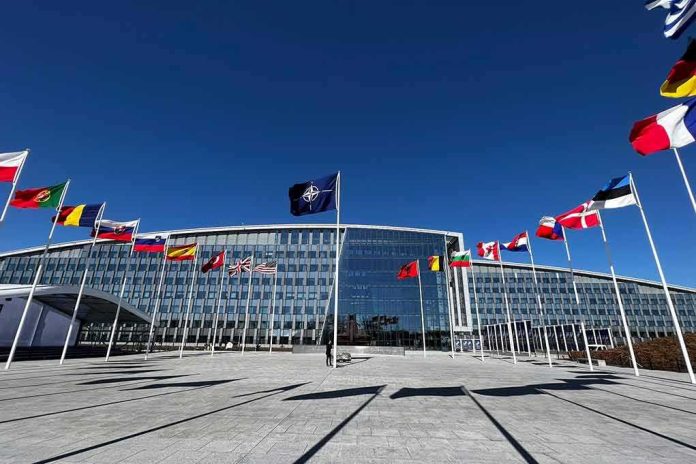
U.S. Defense Secretary Pete Hegseth has told NATO leaders that the era of Europe depending on America’s blank check is over, announcing a six-month Pentagon review of U.S. forces and bases across the continent.[3] Speaking at NATO headquarters in Brussels, he called it a “real review” that will judge whether European nations are finally stepping up to defend their own backyard.[3] Hegseth said the goal is clear: move “fast and irreversibly” toward Europe taking primary responsibility for European defense.[3]
The review, which Hegseth has branded the “NATO 3.0” effort, will examine America’s entire force posture and basing structure in Europe, from permanent garrisons to critical air and naval facilities.[9] He explained that the process will pull in input from U.S. European Command and Congress and include consultations with allies, but warned that “some countries will fail and others will pass with flying colors.”[9] For many conservative Americans, this sounds like long-awaited accountability after decades of lopsided burden-sharing.[12]
‘Shameful’ Allies and the Iran Wake-Up Call
Hegseth’s toughest language focused on what happened during recent operations against Iran, when some NATO partners refused to grant U.S. forces predictable access to bases and overflight rights on their soil.[3] He said these decisions blocked American aircraft and ships from using certain European facilities to strike Iranian targets, forcing U.S. planners to work around supposed allies in the middle of combat.[1] He accused those governments of putting “America’s sons and daughters” at greater risk to avoid political heat at home.[3]
News outlets report that Hegseth directly called this behavior “shameful,” a word that cuts through the usual polite diplomatic talk.[4] He said the new review will judge not just spending numbers, but whether the United States can count on “full access and overflight when we need it.”[2] The public record does not yet name which countries blocked access or show the actual diplomatic cables, which means the picture is still incomplete.[1] But so far, no major ally has stepped forward with a detailed public rebuttal of Hegseth’s charge.[4]
Trump’s Push for Real Burden-Sharing, Not Endless Subsidies
At the heart of the review is a simple question many Trump voters have asked for years: why are American taxpayers still paying to defend rich European welfare states that refuse to shoulder their share? Hegseth warned that some allies are “freeriding” on U.S. protection, failing to show real progress toward a much higher defense-spending target of about 5 percent of their national output by 2035, a benchmark reported from last year’s Hague summit.[12] He signaled that future U.S. support, including NATO dues, will be linked to who actually meets those promises.[7]
Policy experts have argued for years that the current U.S. military posture in Europe is too large and lets European governments underinvest in their own militaries.[16] Studies on alliance politics show that when Washington openly talks about pulling back, European publics do become more willing to spend on defense and take more responsibility.[19] Hegseth’s hard line fits that pattern: it is a pressure campaign aimed at waking up complacent capitals, not an attack on the alliance itself. For Trump supporters, it also answers a deeper fairness issue after years of globalist foreign policy.
What This Could Mean for U.S. Troops, NATO, and American Families
Hegseth and other officials have signaled that the review could lead to changes in U.S. troop levels or locations in Europe, though they have not released specific unit plans.[3] Analysts who have examined past posture reviews say one likely outcome is fewer permanent heavy forces in Europe, with more emphasis on flexible support units and short rotations that can surge when truly needed.[16] That kind of shift would let Europe handle front-line defense while America keeps its fighting strength ready for global threats, including in the Pacific.[21]
For many American families, especially those with loved ones in uniform, the stakes are high. Hegseth is arguing that if foreign governments will not open their bases in wartime and will not pay what they promised, then U.S. troops should not be permanently stuck on the hook to bail them out.[3] At the same time, NATO has long said that a strong, fair mix of forces on both sides of the Atlantic is key to deterring threats.[18] That means this review is not just about numbers on a map; it is about restoring a partnership that respects American sacrifice instead of taking it for granted.
Sources:
[1] Web – Hegseth announces review of U.S. forces in Europe, blasts “shameful” …
[2] Web – Hegseth announces review of U.S. forces in Europe, blasts “shameful” …
[3] Web – Pentagon chief lashes out at NATO allies and announces a review of US …
[4] Web – Hegseth blasts NATO members, announces review of US forces in Europe
[7] Web – Hegseth Blasts NATO Members, Announces Review of US Forces in Europe
[9] YouTube – Pete Hegseth blasts European allies, announces review of American …
[12] Web – Pete Hegseth lashes out at NATO allies and announces a review of US …
[16] Web – Revisiting the Global Posture Review – Marine Corps University
[18] YouTube – U.S. Military Posture and Implications for European Security
[19] Web – Deterrence and Defence Posture Review | NATO Official text
[21] Web – Allies and Congress are about to lose a key window into US military …