
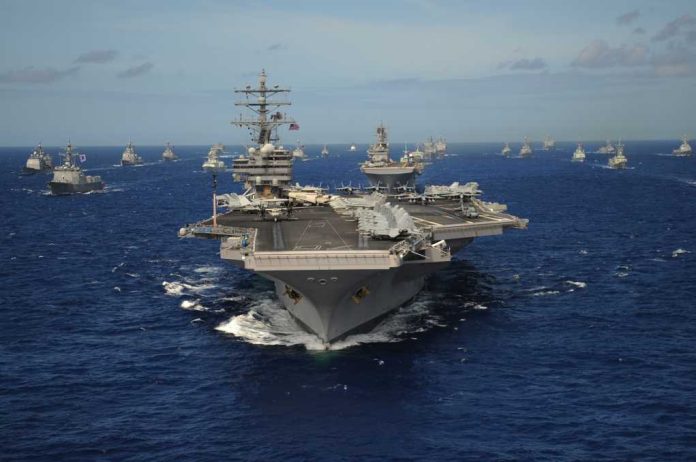
The latest U.S. strikes on nearly a hundred Iranian military targets near the Strait of Hormuz show how a fight over one narrow waterway is pulling America deeper into a war many citizens no longer trust their leaders to manage.
Story Snapshot
- U.S. Central Command says it has completed a third round of strikes on Iranian targets near the Strait of Hormuz after attacks on commercial ships.
- American forces hit roughly 90 Iranian military sites, including air defense systems, coastal surveillance, missile and drone storage, and naval assets along Iran’s coast.
- The U.S. says the strikes are meant to keep the Strait of Hormuz “open to all vessels,” while Iran claims it can close the waterway and has fired on ships that do not follow its route.
- These clashes fit a growing pattern where attacks on civilian shipping trigger tit-for-tat strikes, raising fears of elite-driven war decisions that ignore already‑strained American families.
What The U.S. Says It Just Did And Why It Matters
U.S. Central Command reported that American forces carried out another wave of air and missile strikes against Iranian military targets on July 8, focused on areas near the Strait of Hormuz. The statement said U.S. forces hit about 90 sites, including air defense systems, coastal surveillance equipment, missile and drone storage facilities, naval capabilities, and logistics hubs along Iran’s shoreline. Commanders framed these actions as needed to “degrade Iran’s ability to attack commercial shipping and innocent civilian mariners” and to protect traffic in the narrow strait.
These latest strikes followed earlier U.S. attacks the night before, when Central Command said it had hit about 80 Iranian targets, including more than 60 small boats operated by the Islamic Revolutionary Guard Corps. Those earlier strikes were described as punishment for Iran’s violations of a recent ceasefire and its attacks on three commercial vessels traveling through the strait. U.S. officials argue they are acting in defense of civilian seafarers, but many Americans see another overseas fight decided by leaders who rarely feel the economic pain their choices cause.
How The Strait Of Hormuz Became A Pressure Point
The Strait of Hormuz is a narrow choke point between Iran and Oman where a large share of the world’s oil and gas exports moves by ship. For years, both the United States and Iran have treated it as a test of power and control, with each side blaming the other for new clashes. The Congressional Research Service notes that most U.S.–Iran military flare‑ups since 2019 have started with attacks or threats against commercial vessels in this waterway, creating a cycle that keeps drawing in more weapons and money.
Recent reports show this same pattern again in 2026. Reuters and other outlets describe U.S. strikes that followed Iranian drone attacks on a Singapore‑flagged cargo ship called the Ever Lovely, as it exited the strait along the Omani coast. Central Command labeled its response a “powerful” and “strong” answer to “unwarranted aggression” and said it targeted Iranian missile and drone storage sites near the strait and on Qeshm Island. For ordinary Americans watching from home, this feels less like a clear win and more like another foreign crisis layered onto inflation, high energy bills, and a political class they already distrust.
Competing Claims Over Who Controls The Waterway
Public statements from both sides show a sharp fight over who decides what happens in the Strait of Hormuz. U.S. Central Command has said that “Iran does not control” the strait and insists it is “open to all vessels,” stressing freedom of navigation for global shipping. At the same time, Iranian Revolutionary Guard leaders have declared the strait “closed until further notice” during some clashes, and threatened to target any vessels they view as violating their rules. This push‑and‑pull leaves civilian crews and cargo owners stuck between two governments using them as leverage.
News outlets report that Iran has promoted a route it calls the only “safe” path through its own waters, while U.S. officials have guided commercial ships onto an alternate corridor through Omani waters that they argue is safer and more lawful. Recent attacks struck tankers following the U.S.‑recommended route, leading Washington to claim Iran targeted innocent ships to challenge the earlier memorandum meant to ease tensions. Many Americans on both the right and left see this as one more case where powerful states turn regular workers and businesses into pawns in a larger power struggle.
Open Questions And Growing Public Skepticism
Even as the main facts of the U.S. strikes are clear, some important details remain murky and fuel public doubt. Central Command and major networks describe an Iranian attack on a Cyprus‑flagged container ship, sometimes identified as the MV Galaxy, but have not yet released forensic proof or onboard video that would let outsiders verify who fired which weapon. Reports also differ over whether one, three, or more vessels were hit in the incidents that triggered the latest waves of strikes, creating confusion about the scale of the threat.
U.S. STRIKES IRANIAN TARGETS AFTER IRGC FIRES ON VESSEL
Axios is reporting that the U-S military is striking Iranian targets in the Strait of Hormuz region in response to the Islamic Revolutionary Guard Corps' firing on a vessel.
The report says the ship was fired upon.. just…
— Worldwide News Network (@WorldwideNNX) July 11, 2026
Legal questions also hang over the operation. The U.S. government calls these strikes defensive, but it has not publicly shared the full legal memo explaining which international rules, such as the self‑defense article in the United Nations Charter, it believes apply. For Americans already skeptical of the “deep state,” that lack of transparency fits a wider pattern: decisions made in secret by elites, justified with broad appeals to security, and paid for later by taxpayers, service members, and families facing higher prices and more global instability.
Sources:
facebook.com, cbsnews.com, instagram.com, crisisgroup.org, congress.gov, youtube.com, britannica.com