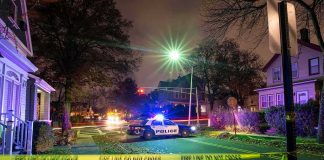

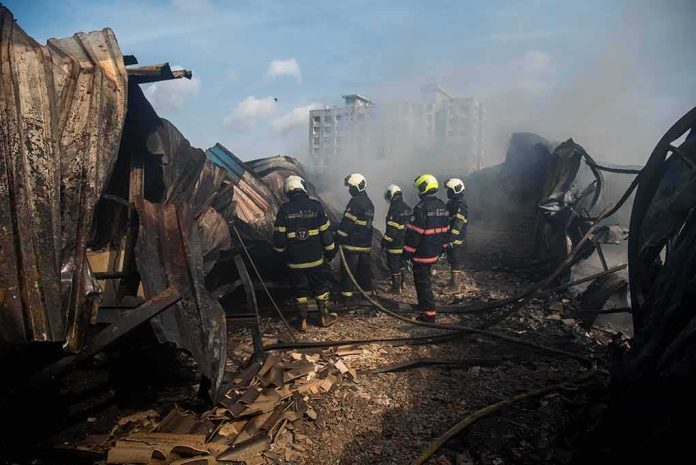
A six‑day warehouse inferno in East Los Angeles is forcing families to seal their homes while officials insist the air is “safe enough,” sharpening public distrust of a system that always seems to react late and explain less.
Story Snapshot
- A cold‑storage warehouse fire in Boyle Heights has burned for days, sending smoke and chemical fumes across Los Angeles.
- Mayor Karen Bass and Governor Gavin Newsom declared emergencies after shelter‑in‑place orders and air‑quality warnings hit working‑class neighborhoods.
- Officials call the response “precautionary,” while residents question mixed messages about toxic smoke, spoiled food, and long‑term health risks.
- The still‑undetermined cause, involving rooftop solar equipment and possible chemical leaks, is fueling anger at both corporate players and government “elites.”
How a Roof Fire Became a Regional Emergency
The Boyle Heights disaster started as a roof fire at a massive cold‑storage warehouse packed with food, foam insulation, and rooftop solar panels. Flames raced across the panels and sent thick smoke and ammonia gas into nearby streets, forcing people in surrounding blocks to stay inside their homes as a precaution.[6] Firefighters stopped the worst of the flames on the roof that first night, but hot spots deep inside the structure kept burning and sending smoke into the air day after day.[1]
As the fire dragged on, the scale of the problem became clear. This single building holds roughly 85 million pounds of frozen food that could rot and become a biohazard once power and cooling were lost.[1] Officials say they must now figure out how to remove mountains of spoiled meat, poultry, and other products without creating new health risks for workers or nearby residents. For families already breathing smoke, the idea of tons of rotting food behind cracked walls feels like one more sign that the system let a dangerous setup grow for years.
Councilmember Jurado remains committed to Boyle Heights residents impacted by the warehouse fire. We’ve distributed 18,000+ N95 masks, 350 air purifiers, and connected families to resources. We’re pushing for a transparent cleanup that prioritizes community health and safety. pic.twitter.com/qshTEvNlQw
— Councilmember Ysabel Jurado (@cd14losangeles) June 22, 2026
What the Emergency Declarations Actually Do
After several days of lingering smoke, Los Angeles Mayor Karen Bass declared a local emergency and asked the state for help. Her order opened the door to disaster funds, outside equipment, and formal smoke‑relief centers for people hit hardest by the fumes.[5] Governor Gavin Newsom followed with a state of emergency, directing California agencies to send more support, including millions of N95 masks, air purifiers, and other supplies meant to protect residents and help firefighters finally put the blaze down.[1][3]
These emergency declarations matter because they shift the event from a “local incident” to a higher‑level disaster with more money and tools available. State leaders say they are acting to protect communities and support recovery as crews battle hidden fires in debris and struggle with falling walls and poor visibility inside the warehouse.[3] But for many people on both the left and right, the big announcements feel familiar: lots of press statements and photo‑ops, while the families closest to the smoke wonder how much protection they are really getting and who will pay for the damage.
Smoke, Chemicals, and Mixed Messages on Safety
Officials admit the smoke plume has spread across wide sections of Los Angeles County and could worsen breathing problems, especially for older people and those with asthma or heart disease.[2][11] Air‑quality agencies have issued special advisories for fine particles, warning that levels have reached ranges labeled “unhealthy for sensitive groups” or worse in some areas.[11] Parks, pools, and kids’ outdoor programs near the fire zone have been shut down because of air‑quality concerns, another blow to families who already feel boxed in.
At the same time, city leaders have tried to calm fears by saying the smoke is not more toxic than a “normal” structure fire, and that dangerous chemicals like ammonia have been contained or not detected at high levels in surrounding neighborhoods.[1][2][3] This technical language does little to comfort residents who smell plastic in the air, feel burning in their throats, or had to flee to shelters after earlier shelter‑in‑place orders. When leaders say the air is “not dangerous” while also handing out masks and telling people to stay inside, it feeds a sense that elites are downplaying risks to protect themselves and big companies.
Shelter‑in‑Place and the “Act First, Explain Later” Pattern
Authorities ordered people around the warehouse to shelter in place when thick smoke and an ammonia leak made outdoor air risky.[3][10] Residents were told to shut windows and doors, turn off air systems, and bring pets inside as firefighters worked to contain both flames and chemicals. The order was lifted once the initial danger eased, but had to be reinstated the next day after a hidden fire flared inside a freezer unit and readings suggested a lithium‑ion battery had ignited.[3][3]
This “on‑again, off‑again” pattern is common in industrial disasters. Emergency managers say they have to act fast with incomplete information when possible toxins are involved, then adjust once they learn more.[3] But from the ground, it looks like officials are guessing while families become test subjects. People who already doubt both big business and big government see the same script: risky technology like high‑voltage solar gear and battery systems placed on top of massive food warehouses, weak oversight for years, then confusing orders and limited help once something goes wrong.
Who Is to Blame—and Who Pays the Price?
The official cause of the blaze remains under investigation, but the warehouse operator says it believes the fire started during testing or maintenance on the rooftop solar array done by outside contractors.[2][10] That means multiple companies are involved, each able to point fingers while lawyers and insurers sort out responsibility. Meanwhile, residents in Boyle Heights, a historically working‑class and largely Latino neighborhood, are the ones breathing in smoke and worrying about long‑term health issues with little trust that anyone will be held fully accountable.
For many Americans, this story hits a nerve that cuts across party lines. People who oppose “green” mandates see a solar‑driven blaze at a huge facility as proof that rushed energy policies create new dangers. People who distrust big corporations see a logistics giant using advanced systems above a community that never really had a say. Both sides see a political class—Democrat in this case, but often Republican too—that moves slowly on prevention yet moves quickly to manage public anger once disaster strikes. The question hanging over Boyle Heights is the same one many ask nationwide: when the smoke clears, will anything change for regular people, or will this just become another line in a long list of emergencies that exposed a broken system and then faded from the news?
Sources:
[1] Web – (VIDEO) Los Angeles Warehouse Fire Rages Into SIXTH Day as Newsom …
[2] Web – L.A. state of emergency: What we know about Boyle Heights fire
[3] Web – “Incredible headway” made in Boyle Heights warehouse blaze, LA …
[5] Web – The roof full of solar panels on the very same Boyle Heights building …
[6] Web – Thick black smoke and flames erupted from a solar-paneled …
[10] Web – Knockdown in sight after firefighters gain upper hand on … – LAist
[11] Web – What we know about the Boyle Heights warehouse fire in Los Angeles