A waterway that carries one-fifth of the world’s oil is “reopening,” yet the rules of the game are still being written far from public view.
Story Snapshot
- Tankers are beginning to move through the Strait of Hormuz again, but traffic is still a fraction of pre-war levels.
- Washington and Tehran talk about reopening, yet military commands, lawyers, and insurers hold the real keys.
- High war-risk insurance, possible Iranian tolls, and uncleared mines mean markets may be misreading how fast flows can rebound.
- Ordinary Americans on both left and right will feel the truth of this “reopening” at the gas pump and in their power bills.
Tankers Are Moving Again — But Not Like Before
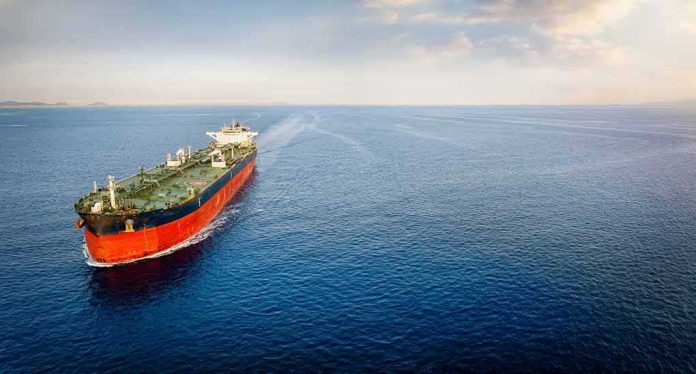
Shipping trackers and news footage now show tankers and cargo ships cautiously returning to the Strait of Hormuz after the latest United States–Iran agreement was announced and the memorandum of understanding text released.[2][10] Reports describe three Iranian tankers leaving the Persian Gulf and several Saudi supertankers starting to cross, carrying millions of barrels of oil toward global markets.[1][7] Other outlets show French, Saudi, and Indian-linked ships among the first to move, while hundreds of vessels still sit idle on both sides of the choke point, waiting for clearer signals from governments and insurers.[3][15]
Analysts at Kpler and other tracking firms say daily crossings are still far below normal, even as some traffic “trickles” through.[4][11] Before the war, roughly 100 or more ships a day used Hormuz; early recovery estimates suggest only about 15 vessels per day at first, with a best-case path toward half of pre-war levels over the next month if everything goes smoothly.[1][3] That gap between a few dozen ships and former full flow is the space where energy prices, company decisions, and household budgets will be decided.
Why Markets Expect a Faster Rebound Than the Waterway Can Deliver
Financial markets are already betting that oil will move more freely now, with some traders talking as if the crisis is basically over and tanker traffic will snap back in days, not weeks.[2][17] Shipping executives offer a more cautious picture. The head of tanker company Frontline said ships will begin moving “very swiftly” once a deal is truly in force, but he and other experts also stress that insurance, security, and routing rules must all line up first.[3] In past chokepoint crises, headlines about reopenings came long before traffic and cargo volumes actually recovered, and the same pattern is forming here.[1][21]
Data firms and maritime analysts warn that full normalization will likely take weeks or even months, not hours.[3][12] They point out that mine risks, damaged infrastructure, and strained supply chains all slow the restart, even after politicians announce peace deals or “full reopenings.”[2] Some experts now predict that tanker flows through Hormuz may only bounce back to 50–70 percent of former levels and could stay there, as some shippers decide to stick with longer but safer routes like the Cape of Good Hope.[6] That is a quiet but huge change for a world economy built on cheap, predictable energy from the Gulf.
The Hidden Brake: Insurance, Mines, and New Tolls
For the people who actually own and insure the tankers, the main question is not what the White House or Tehran say, but who pays when something goes wrong. War-risk insurance premiums that once cost a tiny fraction of a cargo’s value reportedly jumped to around 10 percent, with rates changing by the hour and many underwriters refusing normal coverage until they see stable, on-the-water proof that the danger has truly passed.[2] Industry groups say it will take sustained calm, not just a signed document, before insurers bring prices back toward normal and allow routine transits without special approvals.
Security experts and international agencies also stress that mine clearance in the main international channel is unfinished, which forces many ships to hug Iranian-approved corridors or use southern routes along Oman, often with tracking systems turned off.[2][4] On top of that, Iran’s new Persian Gulf Strait Authority has floated ideas for transit permits and possible fees, which Gulf Cooperation Council states argue would violate long-standing rules of free passage under United Nations sea law.[2] If those tolls stick, some shippers may decide that sailing around Africa, burning more fuel, and passing costs to consumers is safer and cleaner than sailing through a militarized toll booth run by unelected commanders.
Politics Say “Open”; Commanders and Data Say “Not Yet”
Political leaders are eager to claim a win: the President has talked about a “full reopening” of Hormuz, while Iranian officials brag that the United States blockade is gone.[2][11] Yet United States Central Command has publicly said parts of the blockade remain in force for ships bound for Iranian ports until the memorandum of understanding is fully signed and orders change, creating a sharp split between public promises and military rules.[2] That kind of mixed message feeds the belief, on both the right and the left, that everyday citizens are being sold a narrative while the real decisions happen in closed rooms.
Global trackers from the World Trade Organization, think tanks, and private firms show that overall flows through Hormuz are still down 80–95 percent from pre-conflict levels across key cargoes like crude oil, liquefied natural gas, and fertilizer.[3][18][21] Many of the ships that are moving are tied to Iran, China, or other “friendly” partners that have cut side deals, while Western-aligned carriers remain far more cautious.[9][23] For Americans who suspect that powerful governments and corporations look after their own interests first, the sight of preferred cargoes moving while everyone else waits only deepens the sense that the system is rigged.
What This Means for Americans Tired of Being Squeezed
People across the political spectrum know what higher shipping risk means in the real world: unstable gas prices, higher heating bills, and food and goods that cost more by the month. When tankers avoid Hormuz or pay huge premiums to cross, those costs do not vanish. They roll down the chain to refineries, trucking companies, stores, and finally to families already stretched by years of inflation and wage pressure. Both conservatives and liberals who feel locked out of the “elite” economy end up paying for decisions they do not control.
The slow and uneven restart of Hormuz traffic should be a wake-up call about how exposed the United States remains to distant crises and backroom deals. A single strait, controlled in practice by regional militaries and global insurers, can shake household budgets from Ohio to California. As ship traffic crawls back and markets cheer, it is worth asking why a system run by unelected bureaucrats, secretive underwriters, and foreign guards still holds so much power over the daily lives of citizens in a country that was supposed to be built on transparency, equal treatment, and real accountability.
Sources:
[1] Web – Why Hormuz Tankers Will Steam Again Quicker Than Markets Think
[2] Web – Strait of Hormuz Traffic Shows Signs of Increase in Mid-June 2026
[3] YouTube – Tanker traffic resumes in Hormuz after Iran deal signed, data shows
[4] Web – How Strait of Hormuz reopening could unfold after Iran deal – CNBC
[6] Web – OIL TANKERS RESUME MOVEMENT IN STRAIT OF HORMUZ …
[7] Web – Persian Gulf Oil Tanker Traffic May Never Fully Recover
[9] Web – The Strait of Hormuz is splitting into U.S. and Iranian lanes as ship …
[10] Web – Iran War Shipping Update – June 4, 2026 | UANI
[11] Web – Vessel tracker shows Strait of Hormuz as US, Iran reach peace deal
[12] Web – Recovery of ship traffic in Hormuz limited, but signs emerge
[15] Web – Two bulk carriers crossed the Strait of Hormuz on Wednesday …
[17] Web – The State of the Strait: The Role of Hormuz in the Middle East War …
[18] Web – MarineTraffic data shows vessel movement through the Strait of …
[21] Web – Hormuz Live Vessel Traffic & Crude Oil Prices – ShipFinder
[23] Web – Strait of Hormuz – History and Importance to Global Logistics – …