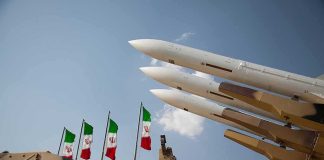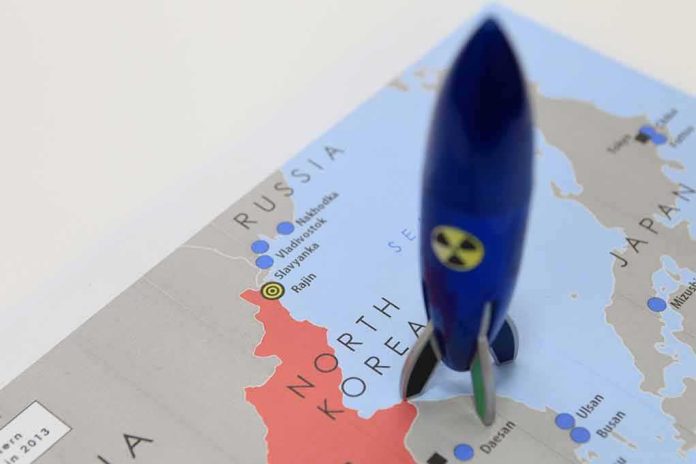
A North Korean intercontinental ballistic missile could reach the American heartland in as little as 33 minutes — less time than most people spend watching a TV show — and the U.S. has no guaranteed way to stop it.
At a Glance
- Expert estimates put North Korean intercontinental ballistic missile flight times to the U.S. mainland at roughly 33–41 minutes, depending on the target city.
- North Korea’s October 2024 missile test set a new record for flight duration, with the missile staying airborne for 86 minutes and reaching an altitude of over 7,000 kilometers.
- Cities like Los Angeles, Chicago, and New York all fall within the calculated range of North Korea’s most advanced missiles.
- Many independent experts say North Korea has not yet proven it can mount a working nuclear warhead on a missile that survives re-entry — a key unresolved question.
How Fast Could a North Korean Missile Actually Reach the U.S.?
A 2023 simulation by the Beijing Institute of Electronic System Engineering calculated that a North Korean Hwasong-15 intercontinental ballistic missile (ICBM) launched from Sunchon could reach Columbia, Missouri in 33 minutes. David Wright, a physicist with the Union of Concerned Scientists, estimated flight times of roughly 38 minutes to the West Coast and about 40 minutes to New York City. Those numbers leave almost no room for a calm, measured response from U.S. leaders.
An ICBM works by arcing high into space — sometimes thousands of kilometers above Earth — before plunging back down at enormous speed. North Korea’s missiles have been tested at steep, high-angle paths to avoid flying over neighboring countries. Experts say that if fired on a flatter, standard trajectory aimed at the U.S., the same missiles would cover far greater distances. That gap between test data and real-world strike capability is part of why analysts keep updating their estimates.
North Korea’s Missiles Have Grown More Powerful Over Time
In October 2024, South Korea and Japan confirmed that North Korea launched an ICBM that flew for 86 minutes and reached an altitude of more than 7,000 kilometers — the longest flight ever recorded for a North Korean missile. Japan’s defense minister said the missile had enough range to hit the U.S. mainland. North Korea’s state media called the test a success and said it proved the country could strike anywhere in the United States.
North Korea has tested a growing number of ICBM types over the past decade. Its Hwasong-17 and Hwasong-18 missiles represent its most advanced designs. The Hwasong-18 uses solid fuel, which means it can be launched faster and is harder to detect before launch. That shift from liquid to solid fuel is a major step forward that military planners take seriously.
What Experts Still Don’t Know — and Why It Matters
Despite the alarming flight data, several key questions remain unanswered. Many independent analysts say North Korea has not yet shown it can fit a working nuclear warhead onto a missile and have it survive the intense heat of re-entry into the atmosphere. A leaked U.S. intelligence document reported by Reuters in 2023 suggested North Korea’s military parades may “overstate” the real threat its ICBMs pose. The RAND Corporation has echoed that caution, noting that parade displays may not reflect actual battlefield capability.
Still, the trend line is hard to ignore. North Korea has conducted six nuclear weapons tests, with its 2017 blast estimated at 120 to 250 kilotons — far larger than the bombs dropped on Japan in 1945. North Korean missile tests are banned under United Nations Security Council resolutions, but those bans have done little to slow the program. For American families living in major cities, the core question is simple and uncomfortable: if a missile were launched today, would 33 minutes be enough time for the U.S. to detect it, decide what to do, and stop it? Right now, no one can say yes with confidence.
Sources:
youtube.com, usatoday.com, bbc.com, businessinsider.com, blog.ucs.org, reddit.com, foxnews.com, slashgear.com, cnn.com, time.com, en.wikipedia.org, bbc.co.uk, pbs.org, missilethreat.csis.org, english.hani.co.kr, the-independent.com, armscontrolcenter.org, lieber.westpoint.edu, reuters.com, congress.gov, theguardian.com, rand.org, dw.com, ncnk.org, news.sky.com, news.un.org