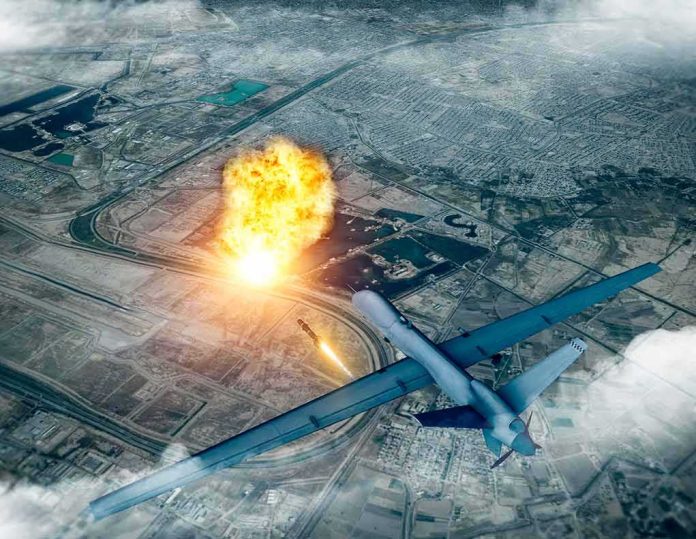
The United States and Iran are now trading strikes almost nightly, with the Pentagon saying it shot down every Iranian ballistic missile fired at American troops this week.
Quick Take
- U.S. Central Command says Iran fired “multiple ballistic missiles” at American forces in an “attempted surprise attack,” and all were intercepted with no injuries reported.
- The U.S. answered with a new wave of strikes inside Iran, hitting coastal defenses, missile sites, and drone facilities.
- This exchange is part of months of back-and-forth fighting stretching from May through July, with strikes tied to threats against ships in the Strait of Hormuz.
- Most of what the public knows comes from the U.S. military’s own statements, since independent proof of damage inside Iran is hard to get.
Iran Fires Missiles, U.S. Says All Were Stopped
Central Command told reporters Iran launched “multiple ballistic missiles” at U.S. forces in the Middle East late Tuesday, calling it an “attempted surprise attack.” The military said every missile was intercepted and no American troops were hurt. The attack came after a short pause in fighting between the two countries over the weekend, breaking what had briefly looked like a cooling-off period.
President Trump responded by saying the U.S. would give Iran a “beating,” signaling more military action was coming rather than a step back from the fight. The exchange marks yet another escalation in a conflict that has run hot and cold for months, with each side blaming the other for restarting hostilities.
U.S. Answers With New Strikes Inside Iran
Central Command said it launched a fresh wave of strikes inside Iran hitting coastal defense systems and missile-launch sites. In an earlier round on July 15, the command said its goal was “to further degrade military capabilities Iranian forces have used to attack commercial shipping in the Strait of Hormuz”. That operation reportedly wrapped up in about 90 minutes, according to Reuters.
This is not the first time. In early July, Central Command said it hit more than 90 targets across Iran’s coastline and released black-and-white footage that appeared to show strikes on an airport runway and missile launchers. A week earlier, on June 1, the command confirmed it intercepted two ballistic missiles fired at bases holding American troops, with no injuries reported.
A Pattern Stretching Back Months
The fighting traces back at least to May, when U.S. forces struck Iranian boats and missile-launch sites the Pentagon said were trying to plant mines in the Gulf. A Central Command spokesman, Navy Captain Tim Hawkins, said the strikes aimed “to safeguard our personnel from dangers presented by Iranian forces”. Days later, U.S. destroyers moving through the Strait of Hormuz came under what the command called “unprovoked Iranian aggressions”.
Since then, the two countries have traded blows again and again. Kuwait and Qatar have both reported being hit by drone or missile fire tied to the wider conflict. Three U.S. service members were killed in one round of fighting in July, prompting new strikes on bridges and power infrastructure in southern Iran near the Strait of Hormuz. Each round follows a similar script: an Iranian attack, an American response, then a pause before it starts again.
What the Public Can and Cannot Verify
Nearly everything reported so far comes from Central Command’s own statements, relayed through news outlets like Reuters, CNN, and NPR. There is no independent satellite analysis or battle-damage assessment in the public record confirming exactly what was destroyed or how badly Iran’s military was hurt. That does not mean the strikes did not happen. It means the full picture of their effectiveness is still incomplete.
Central Command has also declined to specify, in at least one case, exactly where Iran aimed its missiles, leaving part of the threat picture unclear even as officials describe the attacks as unprovoked. For a country still recovering from years of costly overseas conflicts, many Americans on both the left and right are watching closely, wary of open-ended military commitments and skeptical of official narratives that cannot yet be independently checked. The strikes continue, and so does the uncertainty about where this cycle ends.
Sources:
facebook.com, reuters.com, cnn.com, npr.org