
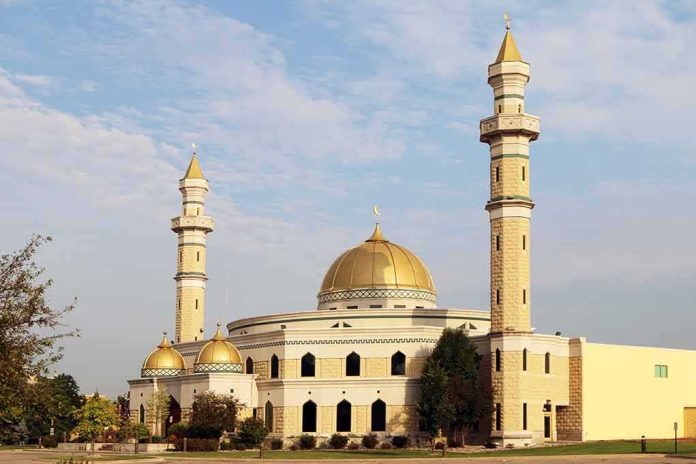
The McKinney City Council voted 7-0 to approve a massive mosque expansion, ending years of fighting over a project that will now add a sanctuary, classrooms and a gym to a Collin County congregation that has worshipped in the city since 1997.
Story Snapshot
- The McKinney City Council unanimously approved a site plan for the McKinney Islamic Association’s campus expansion on Virginia Parkway on August 4, 2026.
- The approved plan covers three buildings totaling roughly 32,573 square feet on 5.575 acres, including a 15,000-square-foot sanctuary.
- City staff said the request was a site-plan review, not a rezoning, and that it met existing development rules.
- The vote came after more than four hours of public comment, with supporters and opponents packing city hall.
- A physical confrontation broke out during the meeting, and former Mayor George Fuller was booed for defending the project.
What The Council Actually Voted On
City file number 25-0081SP asked council members to consider a site plan for religious assembly use at 5301, 5311 and 5321 Virginia Parkway. That is a narrow legal category. The McKinney Islamic Association was not asking to change the zoning on the land. It was asking the city to confirm its building design already fit the rules already on the books.
The Planning and Zoning Commission had already recommended approval three weeks earlier, on July 14, 2026, by a unanimous vote of its own. That earlier recommendation matters because it shows two separate city bodies, staffed by different people, reached the same conclusion before the council ever took its final vote.
The Numbers Behind The Headline
The filed site plan spells out exactly what gets built: a 15,000-square-foot main sanctuary, a 10,236-square-foot classroom building and a 7,337-square-foot gym and multi-use facility. That is a modest, three-building campus on 5.575 acres, not a sprawling single megastructure, whatever the loudest social media posts might suggest.
City staff told the council the plan complied with McKinney’s existing development standards and did not require any variance or zoning exception. Under Texas law, when an applicant meets every applicable standard, a city’s approval of a compliant site plan functions closer to a checklist than a policy debate, whatever the political temperature in the room that night.
Four Hours Of Public Comment And A Physical Altercation
Tuesday’s meeting was not calm. Reporting describes more than four hours of public testimony, hundreds of attendees, and a five-hour marathon session before the final vote. Nearly 70 emails poured into city hall ahead of the meeting, split between support and opposition. Somewhere in that chaos, a physical confrontation broke out, and former Mayor George Fuller told a local news crew he was “taken aback” by what he witnessed while defending the project publicly.
Supporters framed the fight in constitutional terms, telling council members the vote would define “what kind of city McKinney will be remembered as” and arguing the U.S. Constitution guarantees equal treatment regardless of faith. Opponents, including U.S. Representative Keith Self, spoke against the project, and some public comments invoked terms like “political Islam” and “sharia,” pulling a local zoning fight into a much bigger national argument.
A History That Explains The Tension
This was not the association’s first attempt. A 2024 rezoning request for a larger single building drew heavy opposition and was ultimately withdrawn after the Planning and Zoning Commission recommended denial. Vandalism struck a sign marking the future mosque site that same year. The association came back in 2026 with a redesigned plan splitting the project into three smaller buildings, a change that appears to have addressed at least some of the objections that sank the earlier version.
The association has operated in McKinney since 1997 and already runs an existing mosque on Eldorado Parkway. Reporting describes a growing congregation needing more room, though the public record reviewed here does not include audited membership counts or attendance data that would put a hard number on that growth.
What Conservatives Should Weigh Here
Property rights and equal treatment under the law are not abstract conservative talking points, they are the backbone of how zoning is supposed to work in this country. A religious body that follows the same rules as any church, synagogue, or civic building deserves the same administrative treatment, and two unanimous votes, from two separate city bodies, suggest McKinney’s staff applied its rules evenhandedly rather than bending to political pressure in either direction.
That said, the questions raised about traffic, parking, and neighborhood impact were not manufactured out of thin air, and residents living near a busy new campus have a legitimate stake in how those details get resolved at the building-permit stage still ahead. Vigorous public debate over land use is healthy. Rhetoric that recasts a zoning compliance decision as a civilizational threat is not, and it risks drowning out the more useful, boring, and ultimately more important question of whether the city followed its own rules.
What Comes Next
Site-plan approval is not the final word. Building permits, civil engineering sign-off, and other technical reviews still lie ahead before construction can begin. Opponents who lost Tuesday’s vote retain avenues to raise concerns during those later stages, meaning the dispute that consumed five hours of public comment may not be fully over, even after a unanimous 7-0 vote closed this chapter.
Sources:
keranews.org, dallasnews.com, legistar1.granicus.com, particle.news, texasscorecard.com, instagram.com