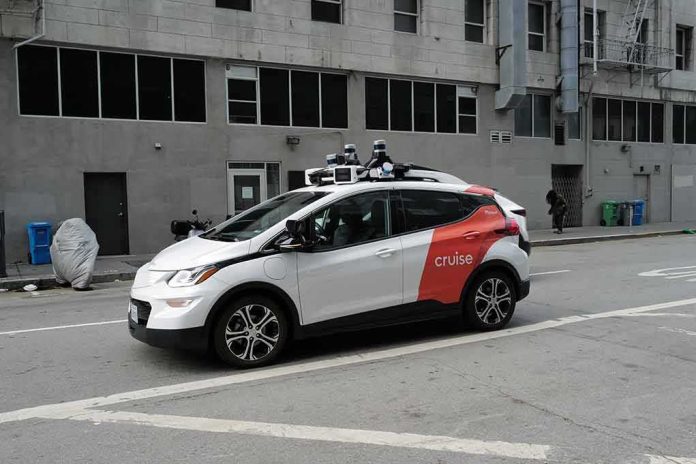
A driverless Waymo in San Francisco spotted a gun inside its own cabin, pulled itself over, and called the police on the two teenagers riding in it.
Story Snapshot
- Waymo says its system detected a firearm violation, stopped the car, and alerted San Francisco police.
- Officers made a high-risk stop and recovered a loaded AR-style “ghost gun” from inside the vehicle.
- Two juvenile riders were taken into custody. It happened before dawn on September 3 in the Richmond District.
- In July, a Waymo alert led San Mateo police to two 15-year-olds — officers simply waited, because the company knew the route.
- The cars have interior cameras running at all times. Waymo says they are for safety and are not used for facial recognition.
What the car did
Shortly before dawn on September 3, in San Francisco’s Richmond District, Waymo’s monitoring systems flagged what the company calls a violation of its terms of service involving a firearm. The car was directed to pull over. Emergency services were alerted. San Francisco police then carried out a high-risk vehicle stop and recovered a loaded AR-style rifle from inside, taking two juvenile riders into custody.
Waymo robotaxi calls cops on riders handling loaded AR-style ghost gun — Waymo alerted San Francisco police, then juvenile riders were stopped and arrested | Tom's Hardware https://t.co/nfWW4YGJwI
— WanderinWoodsman🗺🌐🇺🇸🥋in support of 🇦🇫🇺🇦 (@WanderNWoodsman) September 13, 2026
Strip away the technology and the sequence is remarkable. There was no driver to notice anything, no driver to decide anything, and no driver to make a call. The vehicle noticed, the vehicle stopped, and a remote employee picked up the phone. Arrest allegations are not convictions, and what the teenagers intended is not established. But the chain of events is not in dispute.
How it knew
Waymo runs two sets of eyes. The outside sensors — cameras, lidar, radar — do the driving. A separate set of cameras watches the inside of the car. When the system detects or receives a report of a rule violation in the cabin, it can slow the vehicle, pull it over, and hand the situation to remote specialists who can escalate to emergency services.
The company is open about this. It says interior cameras are essential to safety and incident response, that it does not use them for facial recognition, and that it narrows or challenges law-enforcement requests for data that arrive without proper legal process. Reporting earlier this year also raised a draft policy on using in-cabin data for AI training; Waymo has denied using interior camera footage for ad targeting.
It has happened before
July offered the rehearsal. San Mateo police credited a Waymo alert with letting them stop two 15-year-olds who were allegedly drinking and firing gel pellets from a toy gun out of a moving robotaxi. The detail worth sitting with is how the stop went: there was no chase. Officers knew the car’s location and its route, because the company did, so they waited for it to arrive.
Two incidents in one summer is not a pattern, but it is a procedure: detect inside the cabin, take control of the car and stop it, coordinate with police. In the San Mateo case investigators went a step further and asked Waymo for the video to help decide what to charge. That is the inverse of the ride-hailing era, when reconstructing an incident usually meant taking a driver’s word for it.
The part worth thinking about
A loaded, unserialized rifle in the back of a car is a straightforward danger, and a company that noticed it and stopped is hard to fault. California has been pushing hard on unserialized firearms precisely because they are difficult to trace and move quickly into the hands of minors. On the facts here, the system did what anyone would want it to do.
The harder question arrives underneath that. A car that can recognize a weapon in the back seat is a car that is watching the back seat, continuously, for everyone who rides in it. Waymo says the footage exists for safety and that it resists fishing expeditions from authorities. Those are the right commitments. They are also promises rather than guarantees, and the only people who can check them are the ones asking for the records.
What comes next
Expect two things. Companies running driverless fleets will advertise this capability rather than hide it, because a recovered rifle is the strongest safety argument they have. And cities and states will start writing down what has so far been left to company policy: when an operator must alert police, how fast it must preserve footage, how long it may keep it, and what protects the privacy of the passengers who have done nothing wrong.
For anyone who gets into one of these cars, the practical takeaway is short. The vehicle is not just transportation. It is a recording device with a phone line to the police, and it will use both.
Sources:
latimes.com, nypost.com, businessinsider.com, support.google.com