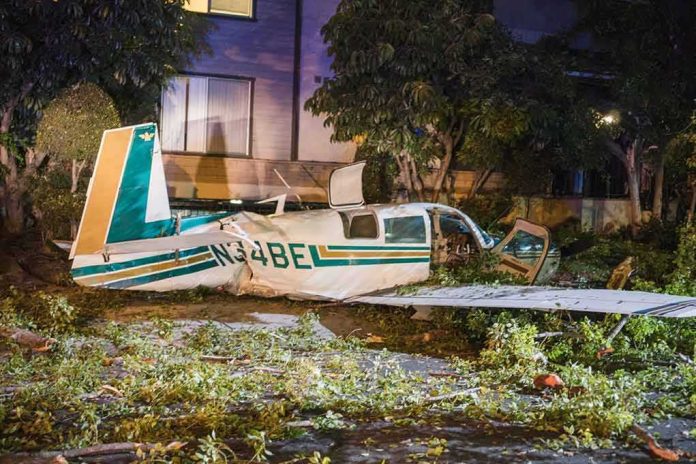
Federal investigators opened a probe after a small plane landing at Carlisle struck a hovering Pennsylvania State Police helicopter, killing the airplane’s pilot and injuring two troopers.
Story Snapshot
- Federal Aviation Administration said a Cessna 150 and Bell 407 collided near Carlisle around 7:50 p.m.
- Pennsylvania State Police said the helicopter was on routine training when the crash happened.
- Two state troopers were injured and are expected to recover; the airplane’s pilot died.
- National Transportation Safety Board is leading the investigation into the midair collision.
What Authorities Confirmed About the Collision
Federal Aviation Administration officials said a Cessna 150 airplane and a Bell 407 helicopter collided in the air near Carlisle, Pennsylvania, at about 7:50 p.m. The National Transportation Safety Board is leading the investigation, as is standard in fatal aviation crashes. Early reports identified the helicopter as a Pennsylvania State Police aircraft. Officials said the collision happened near the airport environment, shortly before both aircraft went down. One person on the airplane died at the scene.
Pennsylvania State Police leaders said the helicopter crew was conducting routine training near a grassy area by the runway when the crash occurred. Officials identified the helicopter occupants as Corporal Bryce Corman and Trooper Jason Mills. Both were taken to a hospital and were expected to recover from their injuries. The agency said the helicopter was hovering when it was hit from behind, damaging the tail rotor and main rotor, and forcing an immediate descent.
Key Details From On-Scene Briefings
Pennsylvania State Police Acting Commissioner George Bivens described the sequence shared at a press conference. He said the airplane appeared to veer sharply right and strike the rear of the helicopter. That impact damaged critical rotor systems on the helicopter. Responders secured the scene and coordinated with federal investigators. Officials did not release the identity of the airplane’s pilot, pending next-of-kin notification. Local hospitals reported the troopers in stable condition after treatment.
Governor Josh Shapiro and police leaders acknowledged the human cost while urging patience as investigators document facts. The National Transportation Safety Board will examine flight paths, pilot actions, and mechanical evidence. The airport operates without a control tower, so pilots use a common radio frequency and visual separation. Investigators will look at how traffic flowed in the pattern, what each crew reported, and how visibility, speed, and geometry affected see-and-avoid.
How Investigators Will Build the Factual Record
National Transportation Safety Board teams typically gather wreckage, witness statements, and electronic data before issuing a preliminary report. Investigators may analyze engine performance, control linkages, and rotor strike marks. They will also review police training plans and the airplane’s recent maintenance. Federal records systems, including the National Transportation Safety Board’s CAROL and docket portals, store documents and photos once released. A preliminary report often posts within weeks, with a final report much later.
National Transportation Safety Board has begun its probe of the fatal mid-air collision that left one private pilot dead, and two Pennsylvania State Police pilots injured. pic.twitter.com/UM6AsxzaJa
— PennLive.com (@PennLive) August 20, 2026
Midair collisions between helicopters and small airplanes near airports are a known risk. Past National Transportation Safety Board cases found that pilots can miss each other until seconds before impact due to visual limits and different flight profiles. Helicopters may hover or fly slower than airplanes, which can create closing speeds that are hard to judge. That is why procedures, radio calls, and clear traffic patterns matter in non-towered settings to keep aircraft separated.
Why This Matters Beyond One Crash
Americans expect government agencies to set clear rules that keep the airspace safe. When a training flight and a local airplane end up in the same slice of sky, people on the left and right ask why basic coordination failed. The answers will shape policy, not just blame. If investigators point to airspace design, training oversight, or communication gaps, then leaders at the Federal Aviation Administration and state agencies will need to fix those weak points fast.
Sources:
yahoo.com, inquirer.com, nbcnews.com, facebook.com, ntsb.gov