
One disputed Iran “victory” headline has reopened a bigger fight: whether powerful newsrooms can be trusted when war—and markets—hang on every word.
Quick Take
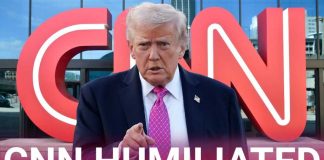
- President Trump blasted CNN after it aired and posted an Iranian statement claiming “victory” and a “crushing defeat” for the U.S. following Trump’s announced ceasefire window.
- Trump alleged the statement CNN highlighted was fraudulent and tied to a Nigerian website, then floated criminal investigation language on Truth Social.
- CNN said it obtained the statement from Iranian officials and that it was also circulating through Iranian state media; a CNN correspondent said Iran issued more than one version.
- FCC Chair Brendan Carr publicly backed calls for “accountability,” escalating the stakes beyond a typical White House–press clash.
What Trump says CNN got wrong—and why it matters in a ceasefire
President Donald Trump’s latest media clash centers on a high-stakes moment: a fragile U.S.-Iran ceasefire window announced after a day of escalating rhetoric. CNN aired and blogged a statement attributed to Iran’s Supreme National Security Council describing “victory” and a “crushing defeat” for the United States, alongside a claim that Washington accepted an Iranian “10-point plan.” Trump responded on Truth Social by calling the material a “FRAUD,” demanding corrections, and hinting at investigations.
The practical issue is less about cable-news drama and more about information discipline during a crisis. When the public is trying to understand whether a ceasefire is holding—and when adversaries are messaging for leverage—small differences in language can move perceptions fast. Conservatives have long argued that major outlets too often frame American power as illegitimate or failing; liberals counter that Trump weaponizes “fake news” claims to intimidate the press. This episode feeds both fears, but for different reasons.
Two Iranian messages, one headline: the sourcing dispute at the center
According to reporting on the controversy, Iran circulated multiple messages after Trump’s ceasefire announcement. CNN’s Matthew Chance said one statement came from the Supreme National Security Council—described as more aggressive—while another came from Foreign Minister Seyed Abbas Araghchi and was shorter. That distinction matters because Trump’s criticism zeroed in on the tougher, chest-thumping version. Other outlets reportedly quoted similar language, yet Trump singled out CNN, and the White House rapid response operation amplified the accusation online.
The unresolved part is verification: Trump claimed the statement was linked to a Nigerian site and falsely attributed to Iran, while CNN maintained it had the statement from Iranian officials and saw it on Iranian state media. Based on the available research, no independent adjudication is presented confirming whether the disputed text was fabricated, misattributed, or simply one of multiple official releases. That gap is important for readers, because “fraud” is a serious charge, and war reporting requires higher-than-normal proof.
The FCC angle raises the temperature beyond a normal press spat
FCC Chair Brendan Carr’s public commentary added a regulatory shadow to what might otherwise be dismissed as partisan back-and-forth. Carr argued that pushing a “hoax headline” during a national security moment “requires accountability,” according to cited coverage. Even without a formal action described in the research, the mere presence of an FCC chairman in the dispute signals to broadcasters that the government is watching how crisis narratives spread. For limited-government conservatives, that’s a tricky balance: accountability matters, but so does avoiding politicized regulation.
Why Americans across the spectrum see “elite failure” in this fight
The broader frustration—shared on the right and increasingly on the left—is that institutions seem to protect themselves first. If a major network amplified an inaccurate claim at a critical moment, Americans can reasonably ask why editorial safeguards failed. If a president uses maximal language about criminality without publicly showing proof, Americans can reasonably ask whether government power is being used to pressure speech. Either way, the “deep state vs. the people” frame gains strength when transparency and humility are missing.
The immediate takeaway for voters is to treat wartime headlines like intelligence: provisional until corroborated. The research shows a dispute over what Iran said, which Iranian body said it, and how U.S. media presented it—all while Washington and Tehran were trying to shape the story of who “won.” In a country already worn down by inflation-era distrust and culture-war media, the cost of getting it wrong is higher than a retraction. It’s another hit to public confidence that government and media can handle hard moments responsibly.
Sources:
Trump threatens CNN over its Iran coverage moments after announcing ceasefire plan
Trump Targets CNN in Unhinged Truth Social Meltdown Over War