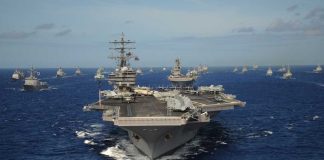

In just 38 days, the Trump administration says it forced Iran to the table—without a U.S. occupation and with the Strait of Hormuz back at the center of global leverage.
Story Snapshot
- Defense Secretary Pete Hegseth and Joint Chiefs Chairman Gen. Dan Caine briefed reporters April 8 on Operation Epic Fury and a two-week U.S.-Iran ceasefire reached just before President Trump’s deadline.
- Officials said the campaign targeted Iranian missiles, naval capability, infrastructure, and nuclear pathways while avoiding the kind of nation-building Americans associate with Iraq and Afghanistan.
- Pakistan’s leaders were described as key intermediaries in last-minute talks that produced the pause in fighting.
- The White House framed the operation as an “overwhelming success,” while the administration warned strikes could resume if terms collapse or maritime traffic is threatened again.
Pentagon briefing frames a fast campaign and a narrow mission
Secretary of War Pete Hegseth and Joint Chiefs Chairman Gen. Dan Caine used an April 8 Pentagon briefing to argue that Operation Epic Fury met or exceeded its objectives in 38 days, aligning with President Trump’s stated timeline. Officials described the operation as a focused military campaign aimed at degrading Iran’s ability to threaten the region—especially through missiles, naval forces, and nuclear-related capabilities—rather than a long-term occupation.
The operation’s start time and presidential authorization were emphasized as part of a command-and-control narrative meant to show clarity of mission. According to the administration’s account, U.S. forces struck at scale while maintaining operational discipline and avoiding the open-ended commitments that tend to expand both budgets and federal power. For voters fatigued by decades of costly Middle East entanglements, that distinction—limited aims, limited timeframe—was central to the messaging.
Ceasefire timing and Pakistan’s role highlight a pressure-and-diplomacy blend
U.S. officials said a two-week ceasefire was reached hours before a Trump deadline tied to reopening the Strait of Hormuz, a chokepoint with major implications for global energy prices and shipping. The reporting and official statements highlighted Pakistan’s Prime Minister Shehbaz Sharif and Field Marshal Asim Munir as intermediaries in the last-minute negotiations. The administration’s posture remained conditional: bombing was suspended, not ended, and could restart if the deal fails.
From a domestic standpoint, the Strait of Hormuz focus matters because energy costs still function like a hidden tax on working families and retirees. When shipping risks rise, fuel and consumer prices often follow, feeding inflation pressure that many Americans already blame on years of overspending and economic mismanagement. The administration’s case is that credible force created negotiating leverage—while diplomacy, routed through a regional broker, delivered a short-term pause without conceding U.S. objectives.
Target set: missiles, naval power, and nuclear capacity—without “nation-building”
Administration sources described a campaign that expanded rapidly from initial strikes into a broader target set, including ballistic missiles and production capacity, with one White House release citing more than 7,000 targets hit by week three. Officials also portrayed Iran as adapting but still losing capability as U.S. firepower increased and Iranian options narrowed. A key claim across the provided material is that the operation aimed to deny Iran a nuclear path and reduce its ability to fund or arm proxies.
That scope matters politically because it connects two long-running anxieties: foreign threats and government overreach at home. Conservatives tend to support decisive action against state sponsors of terrorism while resisting indefinite deployments that grow federal bureaucracy and spending. Many liberals, even when skeptical of military force, share a frustration with wars that lack clear endpoints. The administration’s narrative tries to answer both concerns by arguing the mission stayed limited, measurable, and time-bound.
What’s confirmed, what’s still unclear, and what to watch next
The clearest verified elements in the research are the public briefings, the stated 38-day timeline, and the announcement of a two-week ceasefire connected to maritime security around Hormuz. Less clear—based on the same material—is how durable the “new, more reasonable” Iranian leadership claim is, because the provided sources do not detail the internal political change beyond references to leadership losses and a shift in negotiating posture. That gap is important when evaluating whether this pause becomes peace or simply an intermission.
Next steps will likely hinge on shipping access and compliance during the ceasefire window. If Hormuz traffic normalizes, pressure on oil prices could ease and help tamp down inflation—an issue that dominates kitchen-table politics regardless of party. If the agreement collapses, the administration has signaled it can resume strikes quickly. Either way, the episode underscores a broader voter concern across left and right: foreign crises often expose how much power concentrates in Washington, and how little room ordinary citizens have when elites miscalculate.
Sources:
Secretary of War Pete Hegseth and Chairman of the Joint Chiefs of Staff Gen. Dan Caine
Hegseth reveals covert visit troops fighting Operation Epic Fury
Defense Secretary Pete Hegseth, Gen. Dan Caine to brief media on Operation Epic Fury
Americans Agree That Operation Epic Fury Is an Overwhelming Success
Operation Epic Fury: President Trump’s preference was always the path of diplomacy