

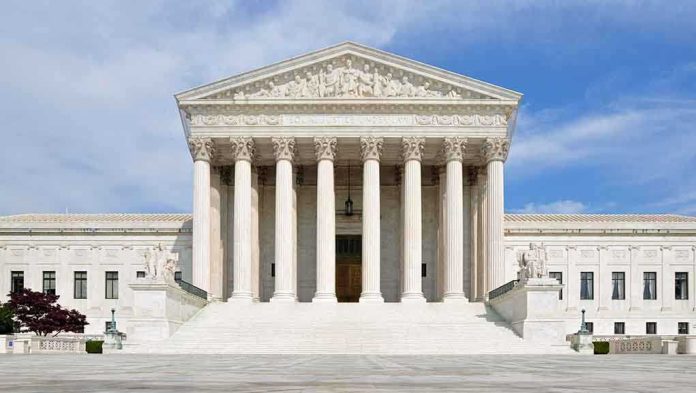
Hours after the Supreme Court reaffirmed birthright citizenship, a freshman lawmaker moved to rewrite who counts as American at birth.
Story Snapshot
- Rep. John McGuire introduced a bill to limit automatic citizenship for some U.S.-born children.
- The bill narrows “subject to the jurisdiction” under the Fourteenth Amendment to exclude undocumented parents.
- The Supreme Court just upheld citizenship for children born here to parents unlawfully or temporarily present.
- The bill would not change the status of anyone born before it takes effect.
What McGuire’s Bill Would Do, In Plain Terms
Representative John McGuire, a Republican from Virginia, filed the Birthright Citizenship Clarification Act. The bill says a child born in the United States would be a citizen only if at least one parent is a United States citizen, a lawful permanent resident, or serving in the armed forces. The text aims to redefine “subject to the jurisdiction” in the Fourteenth Amendment to exclude people who are in the country without legal status. A local report summarized the filing and stated McGuire’s goal plainly.
Congress’s official summary shows a related House measure, H.R. 569, from the same Congress and policy lane. That bill limits birthright citizenship by redefining the reach of the Fourteenth Amendment’s jurisdiction clause. It also states it does not change the citizenship of anyone born before the law begins. McGuire’s push tracks that approach, placing a legal line at the parents’ status, not only the baby’s birthplace. The retroactive carve-out avoids stripping existing citizenship.
House Republican John McGuire introduces Birthright Citizenship Clarification Act to codify Trump executive order https://t.co/Y0bnZ22fJo
— Richard Martin (@lrmartinjr) July 10, 2026
The Supreme Court’s Ruling That Sets the Legal Stage
The legal backdrop is not subtle. The Supreme Court ruled in 2026 that children born in the United States to parents who are here unlawfully or only temporarily are citizens at birth. The Court struck down a Trump executive order that tried to end that automatic citizenship. Court watchers said the opinion relied on longstanding precedent, and they reported the 6–3 split and the core holding with clarity. That makes any new limit a direct challenge to current constitutional law.
Immigration advocates and legal groups described the ruling as an affirmation of the Fourteenth Amendment’s text. They pointed to more than a century of rulings that read “subject to the jurisdiction thereof” to include almost everyone born on United States soil, with narrow exceptions like children of foreign diplomats. Their write-ups said the president cannot change the citizenship rule by executive order, and they framed the Court’s decision as closing that door.
Claims, Rhetoric, and What Is Not Proven
McGuire called current birthright citizenship a “golden ticket” and said migrants pay to cross the border and use United States hospitals to secure benefits for their children. He also said his bill would align with a Trump executive order on the topic. He argued lawmakers must reset policy to protect the meaning of citizenship. Those are his words and goals, but he did not provide documents or data in the interview to prove the payment figure or the order’s details.
There is also a gap between political messaging and legal footing. Even supporters admit the bill would face a steep court test because the Supreme Court just upheld birthright citizenship for children of parents here unlawfully or temporarily. Congress would be asking courts to accept a new read of “jurisdiction” that excludes those parents. The current ruling points the other way. Any change of that size may require an amendment, not a statute, under today’s law.
Why This Fight Resonates Across Parties
Many conservatives see the bill as a pushback on illegal immigration and on what they view as abuse of public benefits. Many liberals see it as a threat to equal treatment and a step toward a two-tier society. Both groups share a deeper worry: the rules feel rigged by elites who dodge hard problems while regular families carry the cost. The clash over who is a citizen at birth goes to the heart of national identity, public trust, and basic fairness in how the system treats people.
“You get a golden ticket, and using taxpayer dollars, you're an American citizen the rest of your life using our benefits, our dollars. It's outrageous, it's ridiculous.”
— Virginia Rep. John McGuire said birthright citizenship should only apply to those in the United States… pic.twitter.com/cckXY4Z8S3
— NEWSMAX (@NEWSMAX) July 10, 2026
The stakes also include hospital costs, school budgets, and state records systems. If Congress passed a redefinition, states would need clear rules on proof of a parent’s status at birth. That would add paperwork, delays, and disputes in delivery rooms and clerk offices. On the other hand, if the current Court-backed rule stands, border and benefits debates will keep shifting to enforcement, work authorization, and asylum policy. Either path demands competence that people often feel Washington lacks.
What To Watch Next
Watch for whether McGuire’s bill gains co-sponsors, especially from committee leaders. Track whether House or Senate committees schedule a hearing to test the constitutional case. Read the bill text for how it handles military service, mixed-status families, and documentation at birth. Expect new lawsuits the moment any such bill moves. Until then, the Supreme Court ruling sets the rule, and babies born here are citizens at birth, with the narrow exceptions already in law.
Sources:
youtube.com, mcguire.house.gov, billtrack50.com, katv.com, x.com