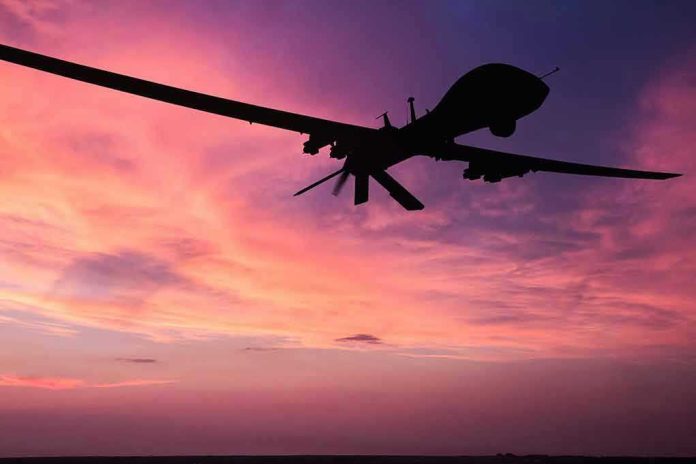
Five unidentified drones brazenly buzzing a French nuclear submarine base should jolt every American who understands how fragile Western security really is.
Story Snapshot
- Multiple drones reportedly overflew France’s primary ballistic missile submarine base at Île Longue in December 2025.
- French naval forces “opened fire” on the drones, underscoring rising concern over unmanned threats to strategic sites.
- The incident highlights how cheaply deployed drones can probe – or disrupt – the nuclear deterrent that underpins NATO security.
- For Americans, the episode is a warning about what happens when Western leaders underinvest in hard security and ignore emerging threats.
Drones Over A Nuclear Submarine Base In Western Europe
The Île Longue naval base in Brittany, on France’s Atlantic coast, hosts the French Navy’s four ballistic missile submarines, the core of that nation’s nuclear deterrent. French outlets including Le Monde and Agence France-Presse reported that on December 4, 2025, as many as five small drones flew over the restricted facility. Early accounts indicate security forces on site detected the aircraft, tracked their movements, and treated the intrusion as a serious potential threat to the base.
Reports state that French Navy personnel “opened fire” on the drones once they were within engagement range, using small arms to attempt to neutralize the unmanned aircraft. Initial information has not confirmed whether any drones were actually brought down or recovered. Authorities have not publicly identified who operated the drones, what payloads they carried, or whether they were conducting hostile reconnaissance, testing base defenses, or simply probing for weaknesses around a high‑value nuclear asset.
Why A French Nuclear Scare Matters To American Conservatives
Ballistic missile submarines at bases like Île Longue are designed to guarantee a second‑strike capability if a nation is ever attacked with nuclear weapons. Any successful sabotage, intelligence collection, or disruption of such platforms erodes deterrence and encourages adversaries to gamble. For American conservatives who prize peace through strength, an incident like this in France is more than a local security scare; it is a signal that Western strategic infrastructure is increasingly vulnerable to cheap, hard‑to‑trace technologies.
Modern drones combine affordability, deniability, and surprising capability, making them attractive tools for hostile states, terror groups, or non‑state actors to test defenses without formally crossing a red line. A handful of off‑the‑shelf platforms can map radar coverage, photograph sensitive facilities, or even deliver small charges against exposed equipment. When those flights occur above one of NATO’s nuclear nerve centers, they implicitly question whether European governments have invested enough in counter‑drone detection, jamming, and layered perimeter security that matches the seriousness of the targets they protect.
From European Vulnerabilities To Lessons For U.S. National Security
The drone incident over Île Longue underscores how Western nations spent years focused on climate conferences, diversity quotas, and bureaucratic rule‑making while enemies experimented with low‑cost tools that bypass traditional defenses. Under President Trump’s renewed emphasis on hard security, border control, and military readiness, the United States is again prioritizing tangible protection of critical assets over symbolic gestures. This French episode provides a real‑world case study of what happens when vigilance falls behind innovation by hostile actors.
Trump‑era priorities, from rebuilding the military to expanding advanced technology testing ranges, were aimed at ensuring America and its allies maintain the upper hand, not just on paper but in the skies above every key base. When a nuclear facility in Western Europe can be approached by a swarm of small drones, it reinforces the case for strong defense spending, aggressive counter‑intelligence, and serious homeland security – not the lax border policies, defunded police forces, and “woke” procurement agendas that defined too much of the previous administration’s approach.
Counter‑Drone Defense, Sovereignty, And The Cost Of Complacency
For constitutional conservatives, this kind of breach touches core issues of sovereignty and security. A nation that cannot guarantee the safety of its nuclear deterrent invites pressure, blackmail, or miscalculation from adversaries abroad. Americans who support the Second Amendment and robust national defense understand that deterrence works only when potential aggressors believe critical capabilities are hardened and ready. Drones circling a submarine base are a visible reminder that the West’s enemies are probing, learning, and adapting every day.
Limited data is publicly available about the December 4 incident, and French authorities have not released a full technical breakdown of the drones involved, their flight paths, or any recovered components. Until more details emerge, observers can only draw careful lessons about the broader pattern: unmanned systems are now central to modern conflict and espionage. For American readers, the takeaway is clear – complacency is dangerous, and strong, focused leadership on national security is not optional but essential.
Sources:
Drone Incursion at French Navy Nuclear Submarine Base