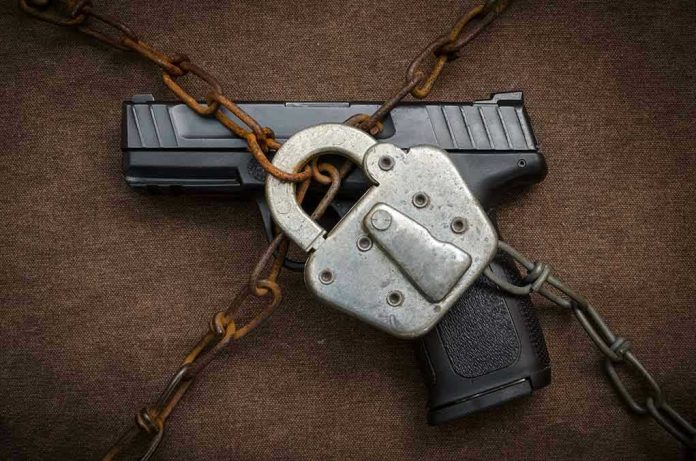
On the very holiday that celebrates American freedom, rival groups are using the Second Amendment to prove that today’s government serves elites—not ordinary citizens.
Story Snapshot
- Gun-control advocates are using Independence Day messaging to push “stronger gun laws” as patriotic and lifesaving.
- Gun-rights supporters see these campaigns as a direct attack on the individual right the Supreme Court has affirmed.
- The fight over guns reflects a deeper anger on both left and right that the federal government is failing ordinary Americans.
- Courts now protect gun rights more strongly than almost any other right, yet also leave room for “reasonable” regulation.
Independence Day Becomes Another Front in the Gun Debate
Independence Day has turned into a yearly battleground over guns, with both sides claiming the mantle of patriotism. Gun-control groups like Brady United and Everytown use July Fourth language about “freedom from gun violence” to argue for stronger background checks, bans on assault-style weapons, and safe storage laws. Supporters say these moves honor the Founders by protecting communities from mass shootings and everyday crime. Critics argue that using a freedom holiday to call for more bans insults the very idea of individual liberty.
Past campaigns show how this script plays out. A Moms Demand Action march in Houston used bikes and wagons to pass out flyers for universal background checks and limits on semi-automatic rifles during a July Fourth parade. A member of Congress wrote an Independence Day op-ed calling for bans on assault weapons and large-capacity magazines while stressing she is a licensed gun owner herself. These efforts send a clear message: true American freedom, they say, means using federal power to tightly control who can own which guns, and how.
Imagine calling for gun control the day after Independence Day https://t.co/bJsNv7b90X
— Ghost of the Ghost of a Renegade Marine (@chattergade) July 5, 2026
What the Supreme Court Actually Says About the Second Amendment
The legal reality is more complex than either side’s slogans. For most of U.S. history, courts treated the Second Amendment mainly as a tool to protect state militias, not a personal right to own guns. Many legal scholars from the late 1800s through the mid 1900s agreed that the amendment did not guarantee an individual right to a firearm. That view shifted in 2008, when the Supreme Court ruled in District of Columbia v. Heller that the Second Amendment protects an individual right to keep a gun at home for self-defense.
Heller was a turning point but not a blank check. The Court struck down Washington, D.C.’s handgun ban while also saying that “longstanding” limits, like keeping guns from felons or bans in sensitive places, could still be lawful. Two years later, in McDonald v. City of Chicago, the Court said this individual right applies to state and local laws through the Fourteenth Amendment. More recently, the Bruen decision set a strict “history and tradition” test, making it harder for governments to justify new gun regulations unless they resemble old ones from the 1700s and 1800s.
Gun-Control Advocates Push “Reasonable Regulation”
Gun-control organizations and civil liberties groups argue that strong gun laws fit within this constitutional framework. The American Civil Liberties Union (ACLU) says firearms “are subject to reasonable regulation” when tied to valid aims like public safety and health. The group will not oppose gun rules that are closely connected to preventing harm and that respect due process and equal protection. In simple terms, they argue that government can limit gun ownership to reduce violence, so long as other basic rights are not violated.
Groups like Brady United echo this approach. They promise to “keep firearms away from those who are less willing to use a firearm responsibly—without infringing on Second Amendment rights.” Their strategy focuses on things like background checks, safe storage laws, and limits on certain weapons. They insist they are not trying to “repeal” the Second Amendment, but to regulate it the same way we regulate cars, drugs, or pollution. For many Americans tired of mass shootings, this sounds like common sense. For many others, it sounds like the slow death of a fundamental freedom.
Gun-Rights Advocates See a Basic Freedom Under Siege
Gun-rights advocates reject the idea that Independence Day gun-control campaigns are just “safety” talk. The National Rifle Association’s Institute for Legislative Action says bluntly that the Second Amendment protects an **individual right** to own firearms for lawful purposes, especially self-defense. They point to Heller and McDonald as proof that this right belongs to ordinary citizens, not just to state-run militias. In their view, every new “commonsense” restriction is another step toward making that right meaningless in practice.
Some conservative thinkers go even further. A Heritage Foundation analysis calls gun rights a key way to defend “God-given, natural rights,” arguing the Second Amendment exists so citizens can protect themselves and their property when government fails. To many on the right, talk of “reasonable regulation” rings hollow after decades of proposals to ban popular rifles, limit magazine sizes, and add complex permit systems. They see powerful politicians, courts, and advocacy groups slowly rewriting the meaning of “shall not be infringed,” while ordinary working people carry the risks of crime and the cost of compliance.
Behind the Gun Fight: Shared Distrust of the Federal Government
Underneath the legal details sits a broader frustration that crosses party lines. Many conservatives feel past “woke” and globalist policies left them poorer, less safe, and less free, and they fear gun bans will lock them into that powerless position. Many liberals feel “America First” politics and cuts to social programs have widened the gap between rich and poor, and they see guns as fuel for domestic extremism and neighborhood violence. Yet both groups increasingly believe the federal government mainly serves elites, not ordinary citizens.
That shared distrust helps explain why Independence Day gun campaigns hit such a nerve. When gun-control advocates use patriotic language to call for more federal power, people who already doubt Washington’s motives see a threat to basic self-defense. When gun-rights activists answer with fiery pro-Second-Amendment messages, people who fear violence see a system that values weapons over children’s lives. The courts now give strong protection to gun rights, but they also leave room for targeted regulations. In this tense climate, each new July Fourth statement or proposal feels less like a policy debate and more like another sign that the system is not listening to ordinary Americans on either side.
Sources:
townhall.com, scholarcommons.sc.edu, constitutioncenter.org, giffords.org, aclu.org, youtube.com, en.wikipedia.org, pmc.ncbi.nlm.nih.gov, shontelbrown.house.gov, bradyunited.org, instagram.com