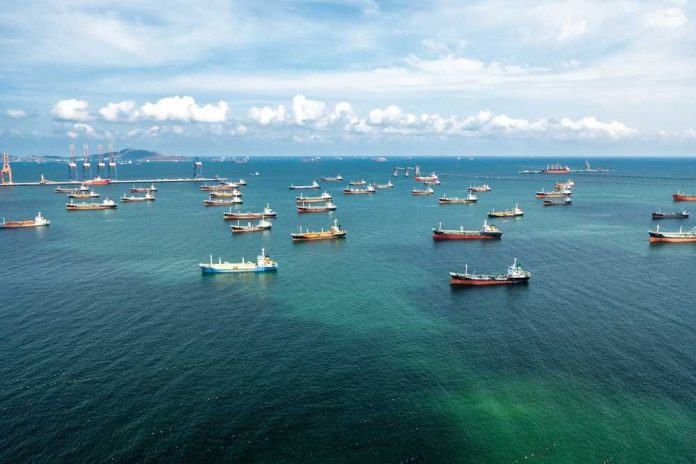
Iran is now openly threatening to hit oil tankers that refuse to follow its approved routes through the Strait of Hormuz, turning a vital global trade artery into a pressure tool against the world.
Story Snapshot
- Iran’s military warns that ships must use its designated routes or face a “forceful response.”
- Tehran is trying to enforce paid, Iran‑approved corridors in a waterway that carries a huge share of the world’s oil.
- The United States, Gulf allies, and shippers say Iran’s tolls and route control violate global maritime law.
- Competing U.S. and Iranian routes leave captains stuck between missile threats on one side and insurance and legal risks on the other.
Iran’s new rules: pay up, ask permission, stay in line
Iran’s top joint military command has warned that all oil tankers in the Strait of Hormuz must use routes it approves or face an “immediate and forceful response” from its armed forces. The statement says any failure to comply with Iran’s navigation protocols, or any deviation from its designated corridor, will “endanger the security” of those ships. Iran’s Khatam al‑Anbiya Central Headquarters adds that management of the strait is exercised “with full authority” by its armed forces, and that all tankers must get permission from the Revolutionary Guard Navy before sailing.
Iran has also mapped out a new shipping lane that pulls traffic closer to its coast and near Larak Island, where vessels can be stopped and inspected by its Revolutionary Guard forces. Reports say at least one tanker operator paid Iran about $2 million to pass through this de facto “safe” corridor after vetting and diplomatic talks. Tehran insists this system is about safety and sovereignty, and has told the International Maritime Organization that claims it is blocking the strait are “misleading.” But most global shipowners still avoid the chokepoint or refuse to pay what they call a “Tehran tollbooth.”
Global pushback: freedom of navigation vs. Iran’s leverage
Maritime law experts say Iran’s tolls and tight route control clash with the long‑standing rule of “transit passage,” which lets ships move through key straits without paying for the right simply to pass. Studies of major natural chokepoints like the Bosporus, Malacca, and the Strait of Gibraltar show no modern example of mandatory transit tolls; fees are limited to optional services such as tugboats or pilotage, not the passage itself. Iran’s plan to charge for basic transit through Hormuz would be a sharp break from this pattern and could change how global trade works if others copy it.
The United States and many Gulf Arab states argue that Iran has no legal authority to block or price basic shipping traffic, even in wartime. A recent United Nations Security Council resolution condemned Iranian attacks and threats aimed at closing or obstructing navigation through the Strait of Hormuz, calling such moves a “serious threat” to international peace and security. U.S. Central Command has stressed that its blockade targets ships going to and from Iranian ports but “will not impede freedom of navigation” for vessels headed to other destinations. Washington has also sanctioned Iran’s Persian Gulf Strait Authority, branding its toll scheme an effort to “extort global maritime trade.”
Dueling routes, real risks, and a shaky peace
While Iran demands ships hug its coastline and seek its approval, the United Nations’ International Maritime Organization and Oman have drawn a new alternative route along Oman’s shore. Several tankers, led by the Stoic Warrior, have already used this path, sailing near the Musandam Peninsula with backing from U.S. and allied air cover. Iran’s Revolutionary Guard calls this Omani‑side lane “unacceptable and completely dangerous” and says “vessel traffic outside” Iran’s declared routes is banned, warning that “violators will be dealt with.”
On the water, this clash leaves ship captains stuck in the middle. Some radio warnings from Iranian forces have told vessels they are “not allowed” to transit the strait, and one tanker was told it was “in range of my missiles” and might be fired on. At the same time, Western insurers and U.S. guidance point ships toward the Omani corridor, raising fears that following Iran’s route and paying its tolls could expose them to U.S. seizure or sanctions instead. This confusion has slowed traffic, driven up oil prices, and shown how a single narrow waterway can be used as a weapon against regular people who just need affordable fuel.
What this means for Americans and the “deep state” worry
Fights over the Strait of Hormuz reach into daily life far from the Gulf. This narrow channel carries roughly a quarter of global oil flows, so any threat or halt there hits gas prices, home heating bills, and the cost of moving goods. Iran’s push to turn passage into a paid, controlled corridor could bring it billions in revenue, easing sanctions while letting it pressure rivals without firing a shot. That kind of leverage worries both conservatives and liberals who already feel that distant regimes and unaccountable global bodies play games with basic needs like energy and trade.
At the same time, many Americans feel burned by their own government’s choices in endless foreign conflicts. Legal experts note that if Iran’s tolls and route controls stand, other coastal states might try the same move at other chokepoints, putting more power in the hands of unelected elites and security bureaucracies. For citizens who believe a “deep state” on all sides puts strategy and profit ahead of ordinary families, the Hormuz showdown looks less like a faraway dispute and more like another warning sign: when great powers turn trade routes into weapons, regular people pay the price first and longest.
Sources:
military.com, lloydslist.com, cnbc.com, yahoo.com, facebook.com, inss.org.il, internationallaw.blog, maritime.dot.gov, brookings.edu, instagram.com, crisisgroup.org, derasat.org.bh