

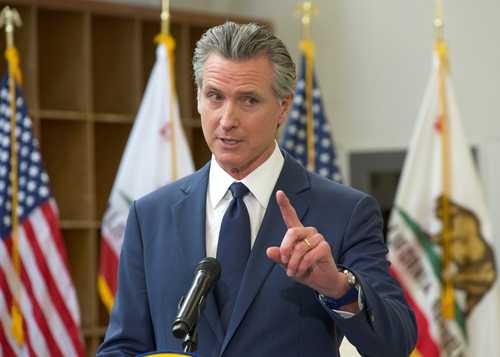
California’s governor is calling the state a growth success story while the data shows a state that is gaining people from abroad but still losing its own residents.
Story Snapshot
- California’s official numbers show modest overall population growth driven mainly by international migration.
- Moving company and Census data show large net losses of residents to other states, fueling talk of a “California exodus.”
- Gavin Newsom is accused of using selective statistics to deny mass outmigration and downplay deeper economic and quality-of-life problems.
- Both right and left see this fight over numbers as another sign that political leaders spin data instead of fixing the system.
What Newsom Says About California’s Population
Governor Gavin Newsom has repeatedly claimed that California’s population is growing again and that talk of a mass exodus is “complete bullshit.” State data backs him up on one narrow point: the California Department of Finance reported that the state’s population increased by about 108,000 residents in calendar year 2024, marking the second year in a row with overall growth. Federal revisions to earlier estimates also turned what were reported as declines in 2023 and early 2024 into small gains. Newsom points to these numbers to argue that California is still attractive and that doom-and-gloom stories from his critics are exaggerated or politically driven, especially from conservatives who dislike blue-state policies and environmental rules.
Mass immigration is regime change through colonization. It's how Democrats flipped California from the red state of Reagan & Nixon to the radical leftist state of Gavin Newsom.
California voters tried to stop it with 1994's Prop 187, but the Deep State killed it in courts.
— Kevin Briggs (@KevinBriggs1776) July 1, 2026
These official figures, however, hide a key detail that matters to families and workers on the ground. Most of the recent growth comes from people arriving from other countries, not Americans moving in from other states. Between 2020 and 2024, California added about 934,000 international migrants but lost roughly 1.46 million domestic residents to the rest of the country. That means more people left California for other states than came in, even while the total headcount barely inched up. To many residents struggling with high housing costs, taxes, crime, and weak schools, it feels like the government is celebrating a technical win while ignoring the lived reality that neighbors, coworkers, and even their kids are packing up and leaving.
What the Outmigration Numbers Really Show
Critics focus less on total population and more on net domestic migration, which measures how many people move in or out between states. U-Haul’s Growth Index, based on more than two million one-way moves, ranked California dead last in net outmigration for six straight years, meaning it had the biggest loss of residents to other states during that period. Census-based analysis finds that from 2020 to 2024, about 1.47 million more people moved from California to elsewhere in the United States than moved in from another state, equal to nearly four percent of the state’s 2020 population. Those are not tiny adjustments; they represent hundreds of thousands of families choosing different futures in places like Texas, Florida, Arizona, and Idaho, where housing is cheaper, energy costs are lower, and taxes often take a smaller bite.
Media outlets and political opponents have seized on these trends to say Newsom is “lying” or “talking out of both sides of his mouth” when he dismisses the California exodus. Commentators point out that California saw a three-year population decline of about 412,000 people between 2020 and 2023 before the recent small uptick. They argue that the only reason the headcount stabilized is a surge of international immigration that masks the continuing flight of middle-class and working-class residents who can no longer afford the cost of living, feel unsafe in their communities, or are tired of what they see as one-party rule serving the wealthy and connected. For many long-time Californians, this is not just about numbers; it is about a sense that the state they grew up in is being hollowed out while leaders argue over spreadsheets.
Why the Numbers Clash — And What It Means for Regular People
Part of the confusion comes from different ways of measuring change. Total population counts everyone, including new immigrants, births, and deaths. Net domestic migration looks only at moves between states. Newsom leans on the first metric to say California is growing. His critics use the second to show that Americans are leaving in large numbers. Both sets of numbers are technically accurate, but they tell very different stories. This “two-metrics” fight is not unique to California. High-cost states like New York and others have also seen net outflows since COVID, even when immigration temporarily keeps their overall population from falling as fast. For everyday citizens on both the right and the left, the deeper worry is that leaders are choosing whichever metric makes them look good while dodging hard questions about housing, schools, crime, and taxes.
I’ve been an advocate for families in California for 11 years, working on legislation and building relationships with politicians on both sides of the aisle.
I was raised to vote Democrat. My parents were farmworkers, and so were my grandparents. Growing up, all I ever heard was… pic.twitter.com/9o4zYvlYCF
— Denise Aguilar (@InformedMama209) July 1, 2026
The broader national data adds more context. Research shows that most states saw slower population growth in 2025 as international migration declined, suggesting that California’s brief rebound was fragile and heavily dependent on federal immigration policy. Studies on domestic migration also find that people are leaving expensive mega-states and moving to suburbs, exurbs, and lower-cost regions, often for work and housing reasons. In California, half of adults who left in the 2010s cited job issues, about a quarter cited housing, and another fifth cited family as the main reason. These patterns match what many Americans feel: whether they lean conservative or liberal, they see a system where elites in both parties trade talking points while millions of ordinary people have to uproot their lives just to chase a fair shot at the American Dream.
Data Spin, Distrust, and the Growing Gap
This fight over whether Gavin Newsom told his “biggest lie ever” is really a fight over trust. Is he flatly lying about the numbers, or is he telling a narrow version of the truth that leaves out the ugly parts? The state’s own reports confirm small overall growth, but also admit large ongoing domestic outmigration and depend heavily on immigration to balance the math. At the same time, critics and partisan media outlets blast Newsom while rarely engaging directly with the Department of Finance’s detailed methodology, preferring simple attack lines over careful analysis. For many readers across the spectrum, that looks like a rigged game: politicians cherry-pick data, pundits cherry-pick outrage, and nobody in power seems seriously focused on fixing the real drivers of flight — high costs, weak services, and a sense that the system works better for donors and insiders than for working families. In that sense, the numbers dispute around Newsom is less an isolated incident and more a symptom of a federal and state government that feels unmoored from the people it claims to serve.
Sources:
pjmedia.com, newsweek.com, governing.com, foxla.com, facebook.com, youtube.com, instagram.com, foxbusiness.com, uhaul.com, atr.org, thepolicycircle.org