
As three firefighters die in a “burnover” with few hard details released, many Americans see another tragic sign that the system protecting both communities and first responders is breaking down.
Story Snapshot
- Three wildland firefighters were killed and two injured in a burnover while battling fires on the Colorado–Utah border.
- Officials say multiple fires merged into the massive Snyder Fire, which has burned about 28,000 acres with zero containment.
- Colorado’s governor declared a disaster emergency and called in the Colorado National Guard as small communities faced evacuation warnings.
- Authorities praise “bravery” but have released almost no detail on what went wrong, echoing decades of vague entrapment narratives.
What Happened on the Colorado–Utah Fire Line
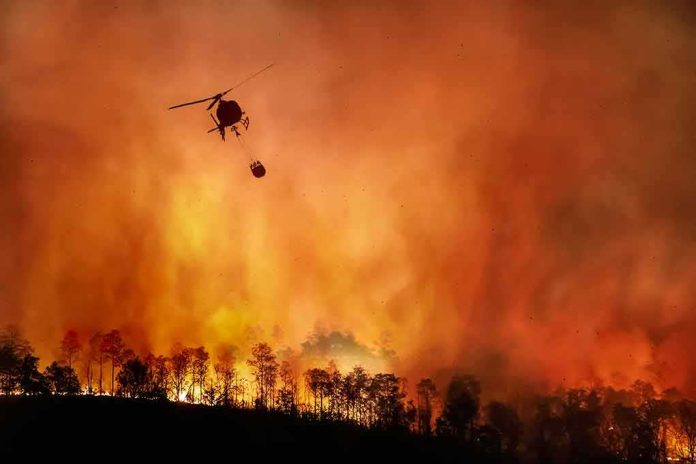
On Saturday, a crew of wildland firefighters was caught in a fast-moving wall of flame while battling fires along the Colorado–Utah border, leaving three dead and two badly burned.[7] Officials say the crew was working the Knowles and Gore fires on the Colorado side when a “burnover” occurred, forcing them to deploy their emergency fire shelters.[1][2] The fires on both sides of the border have merged into the larger Snyder Fire, burning roughly 28,000 acres with no containment reported so far.[1][7] The two injured firefighters are being treated for burn injuries, but officials have not shared their condition or the names of any of the victims yet.[7]
Utah and federal fire officials report that the Snyder Fire started as the Snyder Mesa Fire in Grand County, Utah, before merging with the Jones, Knowles, and Gore fires near the border.[1][4] Pre-evacuation warnings and road closures have been issued in Mesa County, Colorado, as the fire threatens homes and small communities in the area.[1] At the same time, other major blazes are raging across the region, including the Cottonwood Fire in southwest Utah, which has already burned tens of thousands of acres and remains at zero containment, highlighting a growing wildfire crisis in the West.[3][7]
🚨 BREAKING: Three firefighters are dead after battling a wildfire along the Utah-Colorado border.
Officials say three wildland firefighters were killed while fighting the rapidly growing #SnyderFire. Two other firefighters were seriously injured and transported to the hospital… pic.twitter.com/Sdz47r50Lg
— Chase Thomason (@ChaseThomason) June 28, 2026
Official Response and Growing Public Frustration
The U.S. Wildland Fire Service released a statement honoring the firefighters’ “bravery, dedication, and sacrifice,” calling them heroes and promising support for their families.[2] Colorado Governor Jared Polis declared a disaster emergency and authorized the Colorado National Guard to help with evacuations and fire suppression, a move that speeds resources but may also raise questions about whether safety planning kept pace with political pressure to act quickly.[1] For many people on both the right and the left, this tragedy fits a familiar pattern: leaders show up for the cameras after disaster strikes, praise front-line workers, but offer little clarity about how such deadly failures are allowed to happen again and again.
Conservatives who already distrust federal agencies see this as more proof that big government talks about climate and resilience but fails to give firefighters the tools, training, and clear rules they need to stay alive.[18] Liberals who worry about growing inequality see the same pattern from another angle: ordinary workers risk everything while distant decision-makers, often insulated “elites,” face little real accountability when safety breaks down. Both sides can agree on one thing in the wake of the Snyder Fire burnover: the system seems much better at issuing press releases than at learning hard lessons before more lives are lost.
Why “Burnover” Has Become a Troubling Pattern
Wildland fire experts use the word “burnover” to describe a situation where firefighters are suddenly overrun by flames and heat after escape routes or safety zones fail or vanish.[15] Reviews of past incidents show that federal agencies often label fatal events as “burnovers” or “entrapments” within a day, long before full field investigations, weather analysis, and witness interviews are complete.[14] Since the deadly South Canyon Fire in 1994, which killed 14 firefighters on a Colorado hillside, at least a dozen similar entrapment cases have occurred across the West, usually with a familiar script: tragedy, heroic language, and very limited early detail about tactical errors or equipment problems.[6][18] That history has made many observers wary when they hear the burnover label repeated by every major outlet, from wire services to national radio, long before deeper forensic reports are released.[7]
Studies of firefighter entrapments stress that these events almost always involve more than just “bad luck” or extreme weather.[15][18] Common factors include unclear communication, poor mapping of escape routes, underestimation of wind shifts, and failure to adjust tactics as fires grow larger and more complex.[16][19] Yet in the Snyder Fire case, officials have not shared specifics about wind speeds at the time of the burnover, terrain features that may have blocked escape, or whether the crew had reliable safety zones identified before they moved in.[1][2] Without those details, the public is left with a story that feels both tragic and incomplete: brave firefighters died, but we do not yet know whether their deaths were truly unavoidable or the result of avoidable system failure.
What Accountability and Reform Could Look Like
Guidelines for investigating wildland firefighter entrapments call for rapid scene protection, detailed photographs of terrain and burn patterns, and timely witness interviews once crews receive stress support.[14][16] Experts also urge agencies to publish lessons learned and fold them into training so the same mistakes do not repeat every few years.[16] In this case, that would mean releasing the incident action plan for the Knowles and Gore fires, the weather logs for June 27, and a clear timeline of tactical decisions that led the crew into a zone that became deadly.[1][15] For Americans watching from far away, the stakes go beyond one fire: either the Snyder Fire burnover becomes another vague entry in a long list of tragedies, or it becomes a turning point where agencies finally embrace full transparency about what went wrong and how they will change before the next crew rolls toward the flames.
Sources:
[1] Web – 3 firefighters killed, 2 injured while tackling wildfires on the …
[2] Web – Three Firefighters Killed, 2 Injured in Snyder Wildfire on Utah …
[3] Web – 3 firefighters killed responding to Snyder wildfire on Utah-Colorado …
[4] Web – Three firefighters killed as wildfires rage across the Southwest …
[6] Web – Three firefighters killed, 2 injured in Snyder wildfire on Utah …
[7] Web – South Canyon Fire Entrapment Fatalities 1994
[14] Web – Three firefighters killed while tackling major wildfires along …
[15] Web – [PDF] Investigating Wildland Fire Entrapments
[16] Web – [PDF] Wildland firefighter entrapment avoidance: modelling evacuation …
[18] Web – Predicting Firefighter Injury and Entrapment in Urban … – PMC – NIH
[19] Web – A review of US wildland firefighter entrapments: trends, important …