

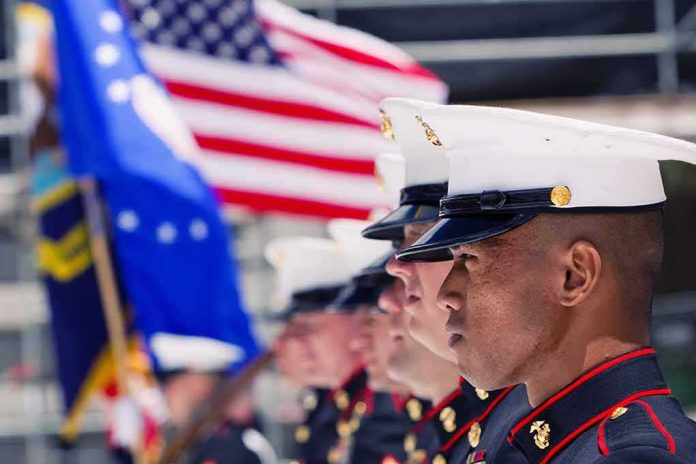
Johnny “Joey” Jones did not just get honored at the Pentagon; he was publicly brought back into Marine Corps service in a ceremony that turned memory into paperwork.
Quick Take
- The reenlistment ceremony was reported for May 20, 2026, at the Pentagon’s Hall of Heroes [1].
- The event included an oath and a reenlistment certificate, which gives it more weight than a routine tribute [1].
- Jones’s long Marine background, combat injuries, and public veteran profile make the story plausible on its face [2][3][4][6].
- The biggest unresolved question is administrative: what status, authority, and duty obligations came with the reenlistment [1].
The Ceremony That Changed the Story
Marine Corps Staff Sgt. Johnny “Joey” Jones was reported to have reenlisted at the Pentagon on May 20, 2026, with Secretary of War Pete Hegseth administering the oath in the Hall of Heroes [1]. The coverage describes a formal military action, not just a symbolic salute. That distinction matters. A ceremony can honor service, but a reenlistment changes the conversation from applause to service status, and that is where the public record gets thinner.
The transcripts say a reenlistment certificate was signed and that Major General W. Field officiated the event [1]. That detail gives the moment institutional shape. Jones was not described as receiving a plaque or a medal for past sacrifice. He was described as rejoining the Marine Corps. For readers who have watched too many glossy military stories blur ceremony and substance, this is the part worth pausing on. The paperwork, not the applause, is the real hinge.
Why Jones’s Return Carries Weight
Jones’s public identity already fits the profile of a man whose service never really left him. Multiple biographies describe him as a Marine veteran, a combat-wounded Staff Sergeant, and a former Marine Corps explosive ordnance disposal technician [2][3][4][6]. The transcript also says he served in Iraq and Afghanistan and disabled more than 80 improvised explosive devices before being injured [1]. That background does not prove reenlistment by itself, but it explains why the story resonated instantly.
Jones also put his own motive on the record. According to the transcript, he said he was reenlisting not for medals or recognition, but to continue serving and supporting fellow Marines and explosive ordnance disposal personnel [1]. That is the sort of statement that lands with common sense. Men who have already paid a serious physical price often speak more credibly about duty than about prestige. Americans still respond to that kind of straight talk because it sounds like service, not branding.
The Missing Details That Matter Most
The public materials do not answer the questions that a serious reader should ask first: Was Jones reenlisted into active duty, reserve status, or some other category? What authority approved it? Was a waiver required because he had previously been medically separated? The available evidence supports the story that something official happened, but it stops short of giving the kind of personnel documentation that removes doubt [1]. That gap leaves room for caution without dismissing the event.
Joey Jones: A Marine’s Unbreakable Spirit and Historic Return to Service
In a powerful and emotional ceremony at the Pentagon’s Hall of Heroes on May 20, 2026, Secretary of War Pete Hegseth administered the reenlistment oath to retired Marine Corps Staff Sergeant Johnny “Joey”… https://t.co/juQwHdGIo9
— IT'S All RIGHT (@itsallrighty) May 20, 2026
That caution is healthy. The same materials that make the reenlistment look credible also lean heavily on celebratory framing [1][2][3]. Military stories often generate a halo effect: the hero is real, the service is real, and the audience then assumes every administrative detail must also be settled. Common sense says not to confuse reverence with verification. The strongest conservative instinct here is simple: honor the veteran, but still ask for the record.
Why the Story Stuck So Fast
This story has the ingredients that spread quickly in public life: a recognizable veteran, a Pentagon setting, a senior official, and a narrative of return after sacrifice [1][2]. That combination is powerful because it speaks to duty, resilience, and continuity. It also explains why derivative coverage can create the impression of ironclad confirmation even when the underlying paperwork remains unseen. In an age of instant certainty, the disciplined response is to value the ceremony while still wanting the order.
Jones’s reenlistment, as reported, fits a broader truth about military culture: sometimes the deepest respect is not a plaque on the wall, but a new set of obligations [1]. If the official record eventually confirms the exact status and authority, the story becomes even stronger. If not, the public will still have witnessed a meaningful ceremony that reflected service, loyalty, and a Marine identity that never quite let go. That uncertainty is the last open loop, and it is the one that matters most.
Sources:
[1] Web – From Military to Public Service, Johnny Joey Jones Is a Voice for …
[2] Web – Johnny “Joey” Jones – Mission Six Zero
[3] Web – JOHNNY “JOEY” J. – Veterans Support Programs
[4] Web – Joey Jones Speaking Fee, Schedule, Bio & Contact Details
[6] Web – See Retired Marine Sgt. Johnny ‘Joey’ Jones Speak in Bossier City