

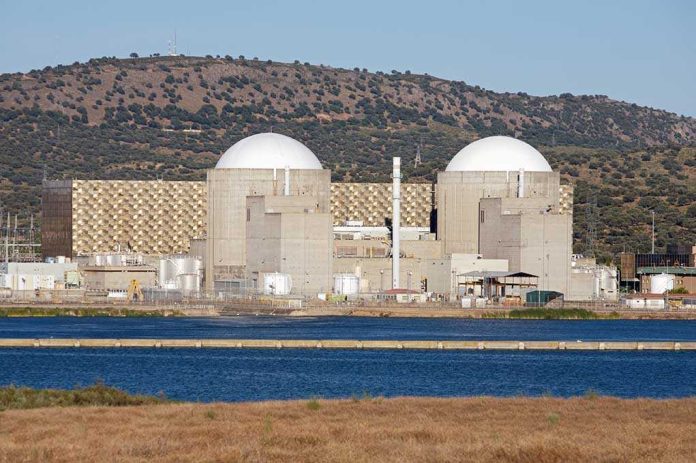
A drone-triggered fire at the Arab world’s only operating nuclear plant exposes a dangerous new front in Middle East escalation—and a direct test of American deterrence.
Story Snapshot
- United Arab Emirates officials report three inbound drones; one struck a generator outside the Barakah plant’s inner perimeter [3][4].
- The International Atomic Energy Agency confirmed no radiological release and normal safety conditions [3][4].
- Public reports tie the strike to the region’s Iran-linked tensions, but no formal public attribution has been released [2][3][4].
- The incident spotlights gaps in critical-infrastructure defense and the urgency of credible deterrence policy.
What Happened At Barakah And Why It Matters
United Arab Emirates authorities said three drones entered from the nation’s western border on May 17, with air defenses shooting down two before one hit an electrical generator outside the Barakah Nuclear Power Plant’s inner perimeter [3]. Officials reported a resulting fire but stated the reactor complex remained secure. The International Atomic Energy Agency confirmed there was no radiological release and that operations and safety levels were unaffected [3][4]. The Barakah facility is the region’s only operational nuclear power station, elevating the strike’s significance [1][3].
Associated coverage across multiple outlets independently described the event as a drone strike that ignited a fire near or at Barakah’s site infrastructure, reinforcing that a real incident occurred rather than a false alarm [1][2][3][4]. Reports consistently identify the damaged asset as a generator located outside the plant’s inner security boundary, which aligns with the absence of radiological impact. This differentiation between outer infrastructure and reactor safety systems is critical to understanding why the plant’s emergency protocols contained risk [3][4].
Attribution: What Is Known And What Is Not
Regional reporting links the incident to the broader conflict environment involving Iran and prior attacks on United Arab Emirates energy assets [2][4]. However, none of the provided public materials include a formal government attribution naming Iran as responsible for this specific strike, and several reports note that no party had claimed responsibility at the time [2][3][4]. The materials do not include debris forensics, launch-point evidence, or authenticated telemetry necessary for definitive public attribution, leaving motive analysis and pattern comparison short of conclusive proof [2][3][4].
The gap between suspicion and verified responsibility demands caution. Rapid headlines and war-risk framing can harden perceptions before technical evidence is public, creating pressure for escalation without a full evidentiary record [4]. Forensic clarity would require serial-number tracing, component provenance, and independent analysis of wreckage, paired with radar, satellite, and electronic intelligence showing the drones’ launch corridor and control. Absent that release, public confidence rests on incomplete data, even as the strategic stakes remain high [2][3][4].
Strategic Stakes For U.S. Policy And Allies
The strike underscores the vulnerability of high-value energy and power nodes to low-cost unmanned systems. Adversaries or their proxies can probe defenses, stress civilian confidence, and challenge deterrence while stopping short of mass-casualty thresholds. American conservatives should recognize the pattern: weak responses invite more risk to allies, energy markets, and deployed U.S. personnel. The United Arab Emirates incident highlights the need for layered counter-drone networks, hardened perimeters, and rapid attribution tools that allow proportionate, lawful, and credible responses [3][4].
UAE reports drone strike at nuclear power plant as Iran war deadlock persists – Reuters https://t.co/TGFYJm8Cml
Follow @NewsHubGlobe for 24/7 breaking news from around the world. pic.twitter.com/ulAOr6Rio2
— News Hub (@NewsHubGlobe) May 17, 2026
For the Trump administration, the immediate priorities are clear. First, close the gaps: accelerate fielding of integrated air and missile defense with advanced counter-drone interceptors and jamming around critical infrastructure. Second, raise costs: coordinate with partners on targeted sanctions against networks supplying components for weaponized drones. Third, demand sunlight: encourage rapid declassification of non-sensitive flight-path and debris data that can establish accountability. Strength flows from clarity; deterrence works when evidence is timely, public, and irrefutable [2][3][4].
Accountability Without Overreach
Principled strength rejects both hesitation and reckless escalation. Conservatives expect firm protection of allies and vital infrastructure, but also insist that any punitive step rest on verifiable facts. The public record here confirms a strike and no radiological leak [3][4]. It does not yet confirm the perpetrator. The path forward is disciplined: secure and share proof, align consequences to that proof, and reinforce defenses so the next drone never reaches a generator—let alone anything closer to a reactor [2][3][4].
Sources:
[1] YouTube – ‘Nuclear Emergency Alert’ In Gulf After UAE Plant Turns …
[2] YouTube – UAE reports fire near Barakah nuclear facility after …
[3] YouTube – Drone strike sparks fire at UAE nuclear power plant in blow …
[4] Web – UAE reports drone strike at nuclear power plant as Iran war …