
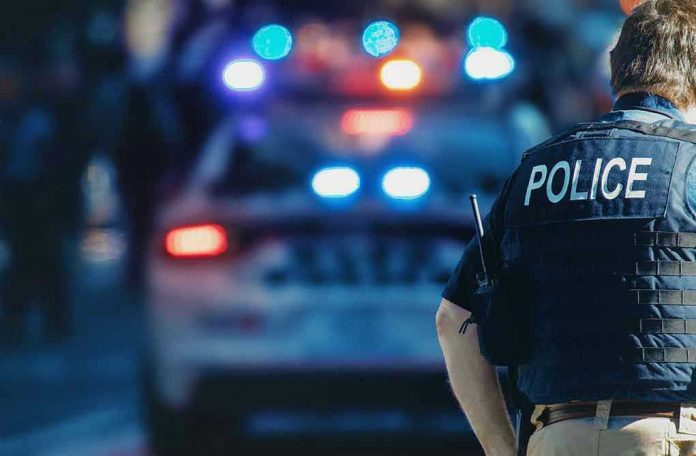
California lawmakers passed a “no-mask” law aimed at federal immigration agents—then Los Angeles’ police chief signaled he won’t put LAPD officers in the middle of what could turn into an inter-agency street confrontation.
Story Snapshot
- LAPD Chief Jim McDonnell said LAPD will not enforce California’s new ban on federal agents wearing masks during immigration operations.
- California’s “No Secret Police Act” (SB 627) and “No Vigilantes Act” (SB 805) took effect Jan. 1, 2026, and require clearer identification while restricting masks.
- The federal government sued California in early January to block the laws, and a judge reportedly signaled the federal side has a strong argument.
- State senators backing the bills accused LAPD leadership of “cherry-picking” which laws to enforce, raising questions about consistent rule of law.
McDonnell Draws a Line: LAPD Won’t Police Federal Agents’ Masks
Los Angeles Police Chief Jim McDonnell said the LAPD will not enforce California’s new state law that bans federal immigration agents from wearing masks during enforcement actions. McDonnell’s stated rationale centered on safety and de-escalation, arguing that confronting armed federal officers over a mask policy is “not a safe way to do business.” In a Fox 11 interview, he described the policy design as “not well thought out,” reinforcing that LAPD won’t insert itself into federal operations.
McDonnell’s position also fits inside the LAPD’s broader posture toward immigration enforcement in Los Angeles: a preference to avoid direct entanglement with federal immigration operations to preserve cooperation from residents who may fear reporting crime. That practical policing concern has been debated for years, but the immediate question is narrower and urgent—whether local officers should be expected to stop or cite federal agents during fast-moving arrests when tensions are already high in targeted neighborhoods.
What California Passed: SB 627 and SB 805, Plus a Matching County Ordinance
California lawmakers adopted two measures in 2025 after public backlash to masked immigration operations: SB 627, branded the “No Secret Police Act,” and SB 805, the “No Vigilantes Act.” The laws extend mask restrictions to federal agents and include identification-display requirements intended to increase accountability during enforcement actions. According to the reporting, the laws took effect statewide on January 1, 2026. Los Angeles County also implemented a mask ordinance effective January 8, 2026, mirroring the state approach.
The political selling point from the bills’ supporters is straightforward: citizens should be able to identify government officers exercising coercive power, especially during high-stakes detentions. But implementation is where the conflict starts. Federal agents cite operational security and personal safety, while local police leaders fear a dangerous clash if city officers try to enforce state rules on federal personnel. The result is a law on paper that depends heavily on which agencies will actually enforce it—and under what circumstances.
Federal Lawsuit Puts the Core Issue Back Where It Belongs: The Courts
Early in January 2026, the federal government sued California to block the new restrictions. Reporting indicates a judge signaled the federal government has a strong argument, including concerns about discrimination against federal agents. That lawsuit matters because it could decide whether California can regulate how federal law enforcement presents itself during federal operations. Until the courts rule, major departments like LAPD appear reluctant to take actions that could escalate into a jurisdictional showdown on the street.
For conservatives who prioritize constitutional structure, this is the real heart of the story: states cannot nullify federal authority, but states do regulate many aspects of public safety within their borders. When Sacramento writes laws that appear designed to obstruct federal enforcement—and when local chiefs then decline to enforce those state laws—the public sees dysfunction instead of clarity. The practical outcome is more confusion, more litigation, and less consistent governance.
Neighborhood Flashpoints and the Trust Problem: Boyle Heights and East L.A.
The backdrop to the legislation is a series of intensified immigration raids beginning in summer 2025 across Southern California, including Boyle Heights and East Los Angeles. Recent reporting says masked federal agents detained at least six people in those areas in the week before the latest headlines. Supporters of the mask ban argue masking fuels fear and makes it harder for residents to verify officers’ legitimacy. McDonnell countered that LAPD data showed no drop in 911 calls despite community anxiety.
LAPD won’t enforce federal agent mask ban: ‘It wasn’t well thought out,’ Chief McDonnell https://t.co/KUN3EVpVvb pic.twitter.com/ChB7KVKrUx
— New York Post (@nypost) February 2, 2026
State Sen. Sasha Renée Pérez, a co-author of SB 805, criticized McDonnell’s refusal and argued that selective enforcement undermines public safety and uniform application of the law. Other lawmakers, including Sen. Scott Weiner and Sen. Monique Smallwood-Cuevas, have defended the legislation as an accountability measure. What remains unresolved in the reporting is who, specifically, is expected to enforce the new rules if major city departments stand down—and whether county agencies will step into a role that could heighten tensions.
Sources:
State senator calls out LAPD chief over mask ban enforcement
Los Angeles police will not enforce California federal agent mask ban
LA mask law, ICE, immigrants, sheriff