
A commercial tanker burned in the Strait of Hormuz after a suspected Iranian strike, underscoring how ordinary ships and ordinary people are caught in a power struggle between armed states and unaccountable elites.
Story Snapshot
- Iran’s Revolutionary Guard said it hit a tanker it claims was helping the United States, but offered no hard proof.
- The struck vessel is a Honduran-flagged, United Arab Emirates–managed ship with a long record of safety problems, not a declared U.S. Navy supplier.
- The attack came as Iran mourned Supreme Leader Ali Khamenei and as a fragile ceasefire with the United States was already under stress.
- Repeated strikes on “enemy” tankers are turning the Strait of Hormuz into a danger zone for global trade and regular workers.
A Tanker Hit And Set Ablaze In A Chokepoint The World Depends On
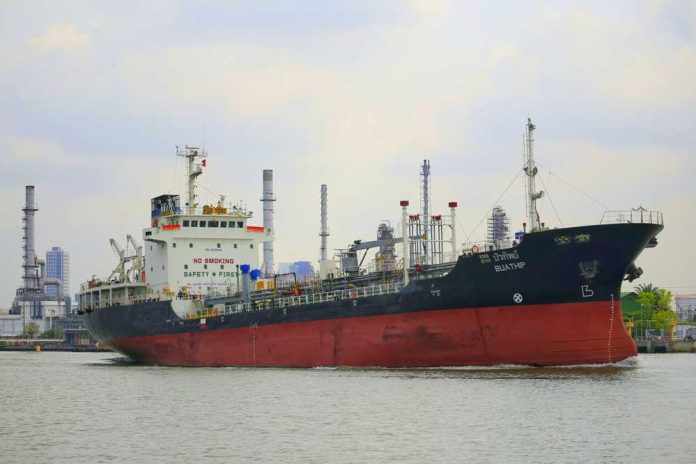
According to reports from maritime tracking services and news outlets, the asphalt tanker Athe Nova was struck by at least one projectile while moving near the Strait of Hormuz, igniting a major fire on board. The Islamic Revolutionary Guard Corps of Iran quickly claimed responsibility, saying the ship was “operating in coordination with America” and calling it an “American ally” that was supplying fuel to United States Navy vessels. The owner and managers did not confirm that claim, and no independent records have yet backed it up.
Vessel data show the Athe Nova sails under a Honduran flag, was built in 1998, and is managed from the United Arab Emirates, not the United States. Maritime analysts note the ship has a long history of port safety inspections and repeated problems, including corrosion, hatch issues, and lifeboat and electrical defects. That pattern points to a worn, lower-standard commercial tanker instead of a special vessel secretly refueling American warships, at least based on public information so far.
Iran’s Justification And The Growing Fight Over Hormuz
The Revolutionary Guard said hitting the tanker was part of “retaliatory strikes” for recent United States and Israeli attacks on Iranian targets. This matches a wider pattern since late February 2026, when Tehran began warning that only “non‑hostile” ships that coordinate with Iranian forces may pass through the strait. Iranian messaging now claims “undisputed sovereignty” over much of the waterway, even though international maritime law treats Hormuz as an international transit passage with a right of free navigation for civilian ships.
At the same time, reports describe Iran setting up a new maritime authority, publishing maps that extend its control zone into United Arab Emirates waters, and insisting every vessel get permission and follow military‑approved routes. More than 1,500 ships from 87 countries are said to be stranded or delayed because of these moves and the wider United States–Iran clash. Together, this shows how one regional struggle can quickly choke off world trade and raise prices for fuel, food, and basic goods that normal families depend on.
Washington, Media Narratives, And A Ceasefire On Life Support
United States Central Command has described recent Iranian attacks on tankers as “continued Iranian aggression against commercial shipping” and has launched its own missile and drone strikes on Iranian military sites in response. Western outlets report the Athe Nova incident mainly as another example of Iran hitting a commercial ship, and they do not present evidence that the tanker truly was aiding United States forces. This leaves two clashing stories: Iran says it is defending itself from foreign attack, while the United States and its allies say Iran is targeting neutral trade.
All of this is happening under a supposed ceasefire and memorandum of understanding between Washington and Tehran that was meant to ease tension and reopen the strait. Each new tanker strike and counter‑strike makes that agreement look weaker and more symbolic, and everyday people see proof that powerful governments struggle, or refuse, to keep their own promises. For both conservatives and liberals at home, this fits a familiar worry: leaders talk about stability and peace, but the actions they take keep the world on edge and the economy unstable.
Why This Matters To Regular Americans On Both Sides Of Politics
The Strait of Hormuz carries roughly a quarter of the world’s traded oil and a large share of liquefied natural gas. When missiles, drones, or gunboats attack ships there, insurance costs jump, routes close, and energy prices can spike far from the Gulf. That means higher costs to drive to work, heat a home, or ship goods across the country. Analysts already warn that continued disruption could trigger a wider food and fuel price shock. Families still recovering from earlier inflation and energy spikes feel like they are paying the price for decisions made thousands of miles away without their input.
🇮🇷 Iran Strikes Tanker Attack Tightens Grip on Hormuz
A Saudi tanker was struck by an unidentified projectile off Oman on July 7, the second ship hit in the Strait of Hormuz in less than 24 hours. The vessel sustained structural damage, but no injuries were reported.
Iran has… pic.twitter.com/y3h5MQellW
— Ryan Rozbiani (@RyanRozbiani) July 7, 2026
This latest tanker fire also shows how murky official claims can be. Iran’s Revolutionary Guard accuses a worn commercial ship of being part of an American war machine, but does not release logs, cargo data, or clear proof. Western governments push back, yet they also rely on secret intelligence and closed‑door talks. Ordinary citizens, whether they lean right or left, see two secretive power centers fighting over control of global trade lanes, while seafarers, port workers, and consumers absorb the risk. It reinforces a shared belief that the “deep state” and global elites treat shipping crews and national economies as chess pieces, not as human lives.
Sources:
military.com, timesofisrael.com, aa.com.tr, facebook.com, ynetnews.com, hstoday.us, cnbc.com, youtube.com