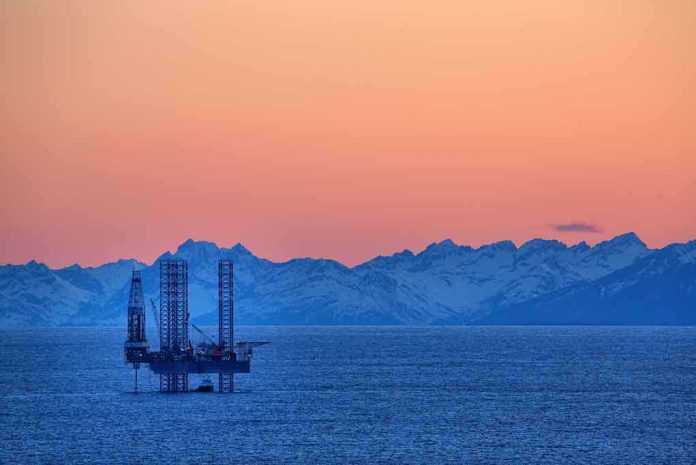
President Trump says the United States secured majority control over 65 billion barrels of Venezuelan oil, but the fine print shows big upside with big risks.
Story Highlights
- The White House claims majority U.S. control of 65 billion barrels in Venezuela.
- Reuters reports a 100-year lease across 17 fields via a private operator.
- Venezuela’s assembly backed the pact while critics question its legality.
- Experts warn production gains and price relief could take years.
What The Deal Says On Paper
The White House said the agreement gives the United States majority control of more than 65 billion barrels of proven Venezuelan oil reserves. The statement called it the biggest oil deal in world history and tied it to goals of stable supply and lower costs for U.S. consumers. Reporting describes a structure that uses a private U.S. firm to operate oilfields under very long leases. Officials cast the plan as a step toward energy security and regional stability.
Reuters detailed proposed terms that include a 100-year lease covering 17 oilfields with an estimated 65 billion barrels in place. The arrangement channels operations through North American Blue Energy Partners, with the United States holding a significant equity stake. Venezuelan lawmakers allied with the ruling party approved the pact, signaling political support in Caracas to move contracts forward and host U.S. officials for follow-on agreements.
President Trump Secures the Biggest Oil Deal in World History. On September 2, the White House released the official, comprehensive account of the biggest oil deal in world history — the agreement securing for the United States majority governance rights, economic ownership, and…
— ĶillBox Gene 🇺🇸 45-47=17+ (@MeanGene212) September 7, 2026
What Could Change For Supply And Prices
U.S. officials argue the deal will lift output and ease prices by expanding supply in the Western Hemisphere. The United States Energy Secretary said new agreements in Caracas could more than double Venezuelan crude output over the next few years. That forecast points to a multi-year build, not an overnight surge, and depends on field work, financing, and logistics across heavy-oil projects that need major upgrades.
Energy analysts routinely warn that reserves on paper are not barrels at the pump. Venezuela’s oil sector needs large capital, new equipment, and reliable power to restore production. Independent outlooks say meaningful gains take years and billions of dollars, especially for heavy crude that requires upgraders and diluent. Even with better access and licenses, improvements arrive in phases and often slip due to politics and market swings.
Where The Pushback Is Strongest
Critics challenge whether Delcy Rodríguez’s government can lawfully bind Venezuela to very long terms. Opposition figures and legal experts argue the deal lacks constitutional footing and could be reversed by future leaders or courts. That fear adds risk to financing and slows decisions by major producers that want clear title, transparent contracts, and stable oversight across decades.
Industry voices also doubt quick gains. Executives told reporters that the targeted fields will take years to develop and may not deliver much soon. Skeptics add that any price relief in the United States will be modest at first because global markets set prices, and new barrels must ramp, move, and refine through constrained systems. Analysts summarize near-term effects as limited while longer-term gains remain possible but uncertain.
Why This Matters Beyond Politics
Americans across the spectrum see a pattern: big promises, slow delivery, and little transparency. The deal could redirect billions into field work rather than into subsidies or short-term fixes, which many see as overdue. Yet the lack of public contract details fuels concern that insiders will profit while families still face high bills at the pump and at the store. Trust will hinge on timelines, audits, and whether savings ever reach consumers.
For Venezuela, the plan could unlock investment and jobs if it holds. For the United States, it could shift supply closer to home and reduce reliance on unstable regions. The stakes are high: a century-long lease claims to tie national wealth to private performance in a country with a fragile system. Citizens should watch three signals: published contracts, production milestones, and actual movement in gasoline prices compared with stated targets.
Sources:
thegatewaypundit.com, cnbc.com, reuters.com, npr.org, finance.yahoo.com, x.com